The Clark Grains Team brings decades of hands-on experience in food-grade grain sourcing, quality assurance, and supply chain traceability. Rooted in three generations of family farming, the team pairs practical agricultural expertise with rigorous documentation standards, including lot-level Certificates of Analysis, USDA Organic compliance, and non-GMO verification protocols. Every article reflects firsthand knowledge of what it takes to move specialty grains from field to processing facility while meeting the exacting specifications food manufacturers, brewers, and industrial buyers depend on.
Procurement managers sourcing specialty grains face pressures that commodity grain buyers never encounter: certification compliance, lot traceability, variety purity, and ingredient consistency, all while managing production timelines that leave little room for substitution. A grain’s genetic makeup, the growing region’s soil and irrigation profile, and the post-harvest handling chain each determine whether a shipment performs as expected in your process or triggers a costly reformulation. Understanding what specialty grains are and where they fit in your supply chain starts with rigorous technical evaluation, not a commodity price sheet.
What Specialty Grains Are Used For
Specialty grains, including wheat, oats, corn, sorghum, barley, rye, triticale, and rice, are distinguished from standard commodity crops by specific genetic, physical, and chemical traits that determine their value in manufacturing rather than bulk trading channels. A commodity bushel of corn is priced on volume and moisture content. A specialty corn variety is priced on starch profile, kernel color, absence of genetic modification, and documented chain of custody. Research from the USDA Agricultural Research Service confirms that genetic and physical traits are the primary drivers of grain end-use value, a finding that shapes how food manufacturers, brewers, and industrial processors specify their purchases. Think of hybrid genetics as a precision-tuned engine: each variety is bred for specific performance characteristics like moisture content, starch density, or color consistency.
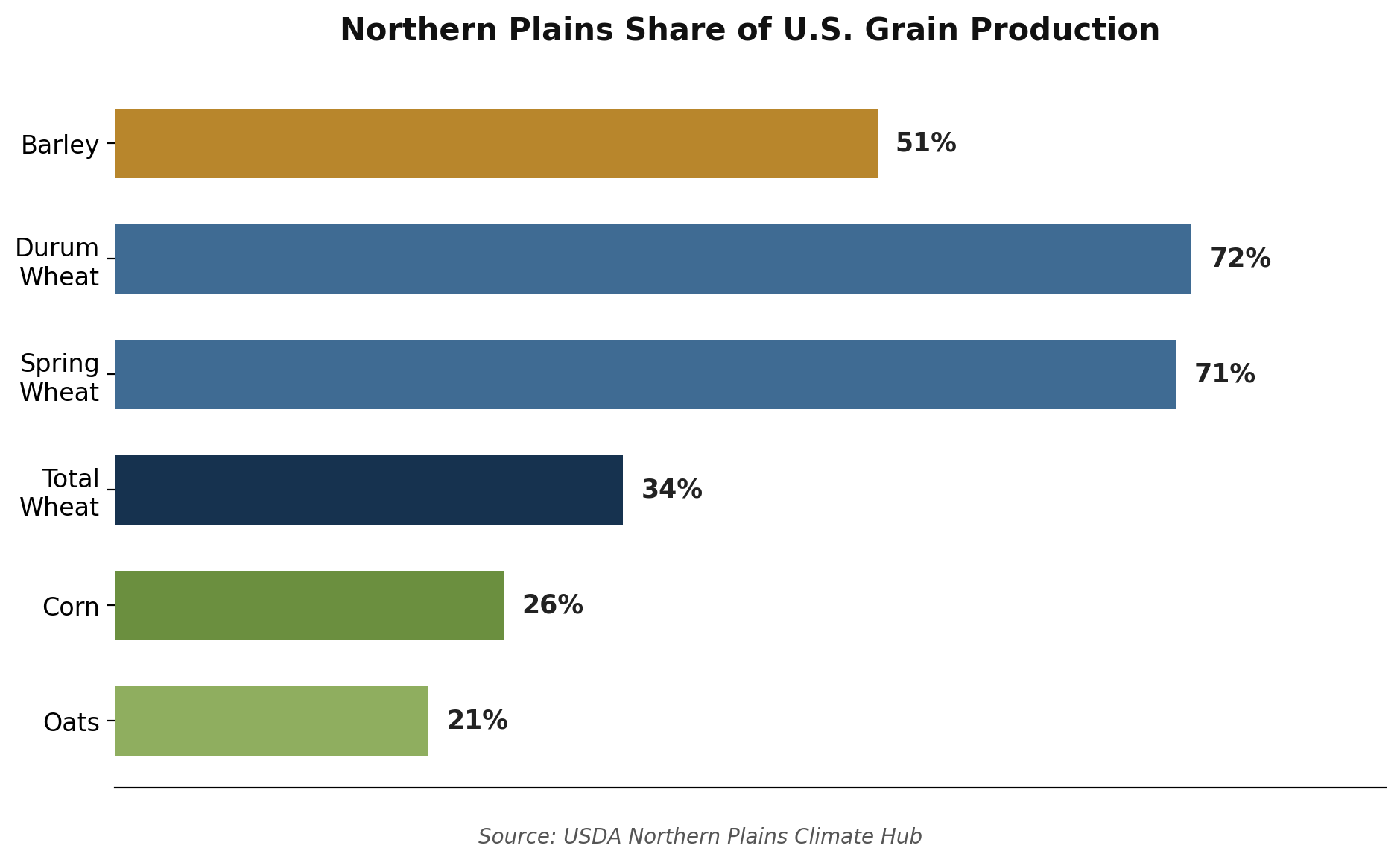
Genetics depend on geography just as much as breeding. A growing region’s soil composition, irrigation access, and seasonal temperature patterns interact with a variety’s genetic potential to determine the grain constituents that reach a processing facility. The Northern Plains, which includes Nebraska, contains 25 percent of total U.S. cropland and 26 percent of its irrigated lands, according to the USDA Northern Plains Climate Hub. That concentration of irrigated acreage matters for specialty crops because consistent soil moisture during grain-filling periods directly affects starch development, protein content, and kernel uniformity. Climate variability in the region presents an ongoing challenge, since shifting temperature patterns and changes in water availability require farmers to adapt through localized genetic selection and crop sequencing to protect the quality benchmarks that specialty buyers depend on.
Common Food Uses for Specialty Grains
Processing pathways dictate value. Across food manufacturing, the primary applications break down into a handful of distinct routes:
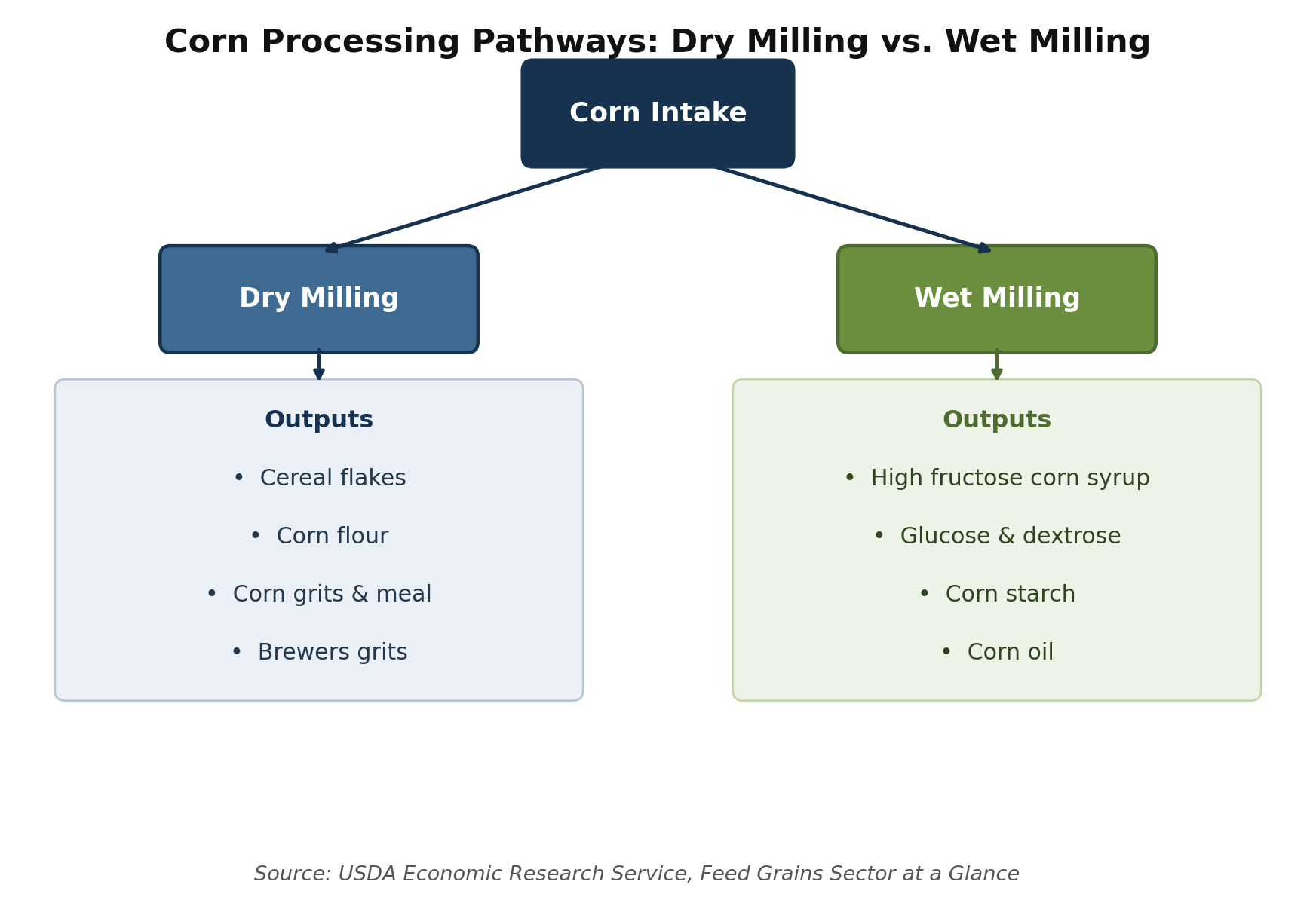
Dry milling of corn produces flakes for cereal, corn flour, corn grits, corn meal, and brewers grits for beer production.
Wet milling of corn yields high fructose corn syrup, glucose, dextrose, starch, and corn oil, each requiring specific starch and moisture profiles at intake.
High-value wheat fractions are developed to produce vital gluten, high-selenium bran, and whole white wheat, increasing both nutritional and economic value.
Oats and sorghum serve distinct roles. Oats are analyzed for nutritional and dietary fiber composition to enhance their use in the food supply, while sorghum’s end-use value depends on interactions among physical grain traits, chemistry, and cooking or processing technique.
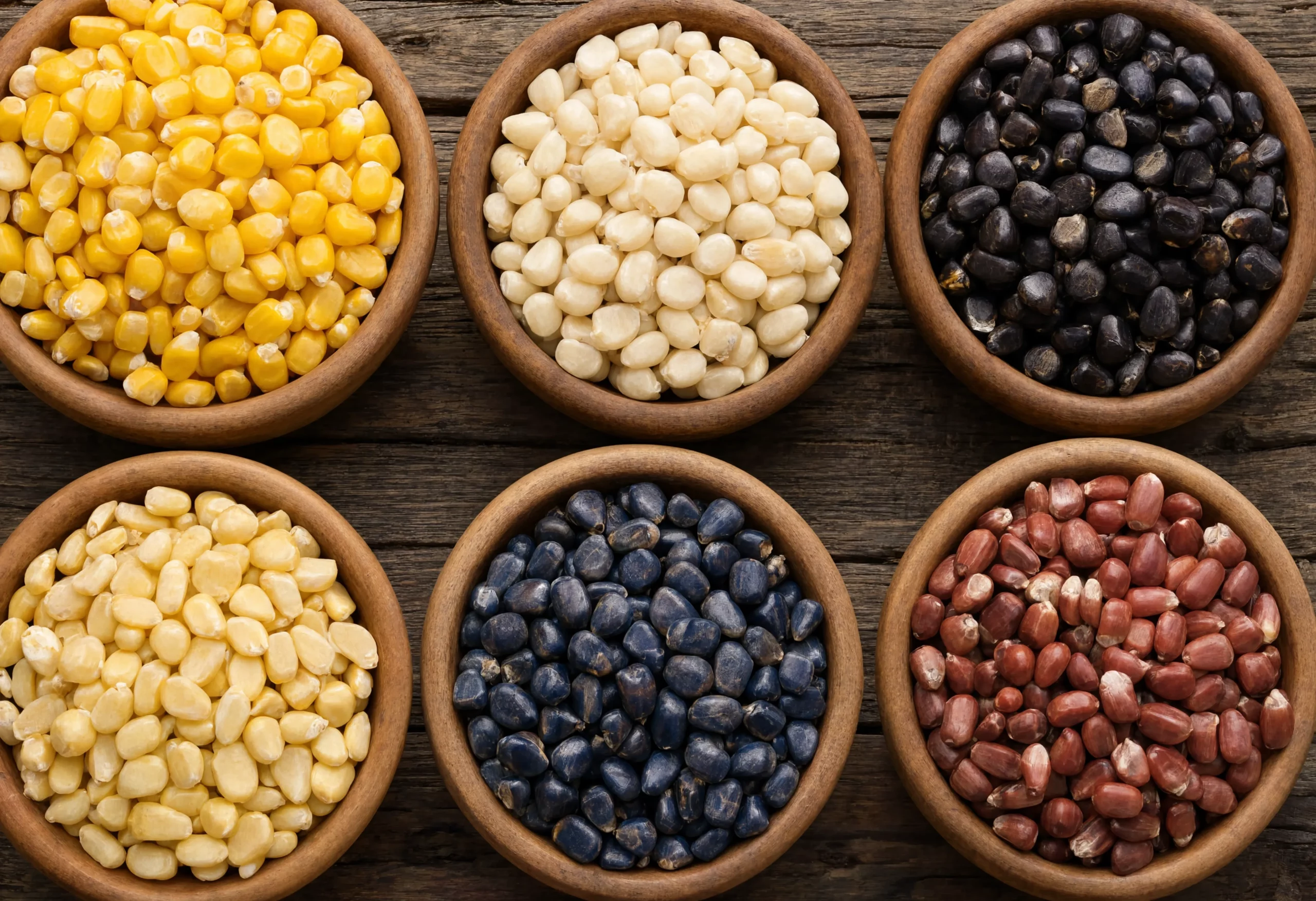
Yellow, white, blue, purple, pink, waxy, and flint corn varieties are processed into specialized ingredients for the snack and tortilla industries, where kernel color and starch composition are non-negotiable specifications.
Specialty Corn, Organic Grain, and Non-GMO Options
Among specialty corn varieties, the distinctions between yellow dent, white, blue, and waxy corn extend well beyond color. Waxy corn’s starch profile, dominated by amylopectin rather than amylose, produces different texture and stability characteristics in food applications than standard dent corn. The exact starch composition differences between waxy and standard dent corn must be verified through lot-specific Certificate of Analysis documentation, since these ratios vary by variety and growing season. For manufacturers requiring USDA Organic, non-GMO Project Verified, or Kosher certification, the sourcing chain must maintain variety segregation from seed through delivery, a requirement that rules out most commodity grain channels entirely.
For food manufacturers requiring strict variety purity and documented quality, understanding the role of identity preservation is critical to protecting a finished product’s label claims.
Specialty Grain Applications by Industry
Food manufacturers evaluate specialty grains for rheological and functional traits that directly affect processing behavior and finished product quality. Specific wheat varieties are assessed for their performance in Asian noodles, tortillas, pizza dough, and flatbreads, applications where protein content, gluten strength, and water absorption interact in ways that make variety substitution technically risky, according to the USDA National Agricultural Library. Corn fractions are processed to develop new food ingredients, nutraceuticals, and bioactive food agents, with research focused on creating blends with enhanced proteins, dietary fiber, and bioactive constituents. The range of specialty corn varieties available through identity-preserved supply chains gives food manufacturers access to specific starch and pigment profiles that commodity channels cannot reliably deliver.
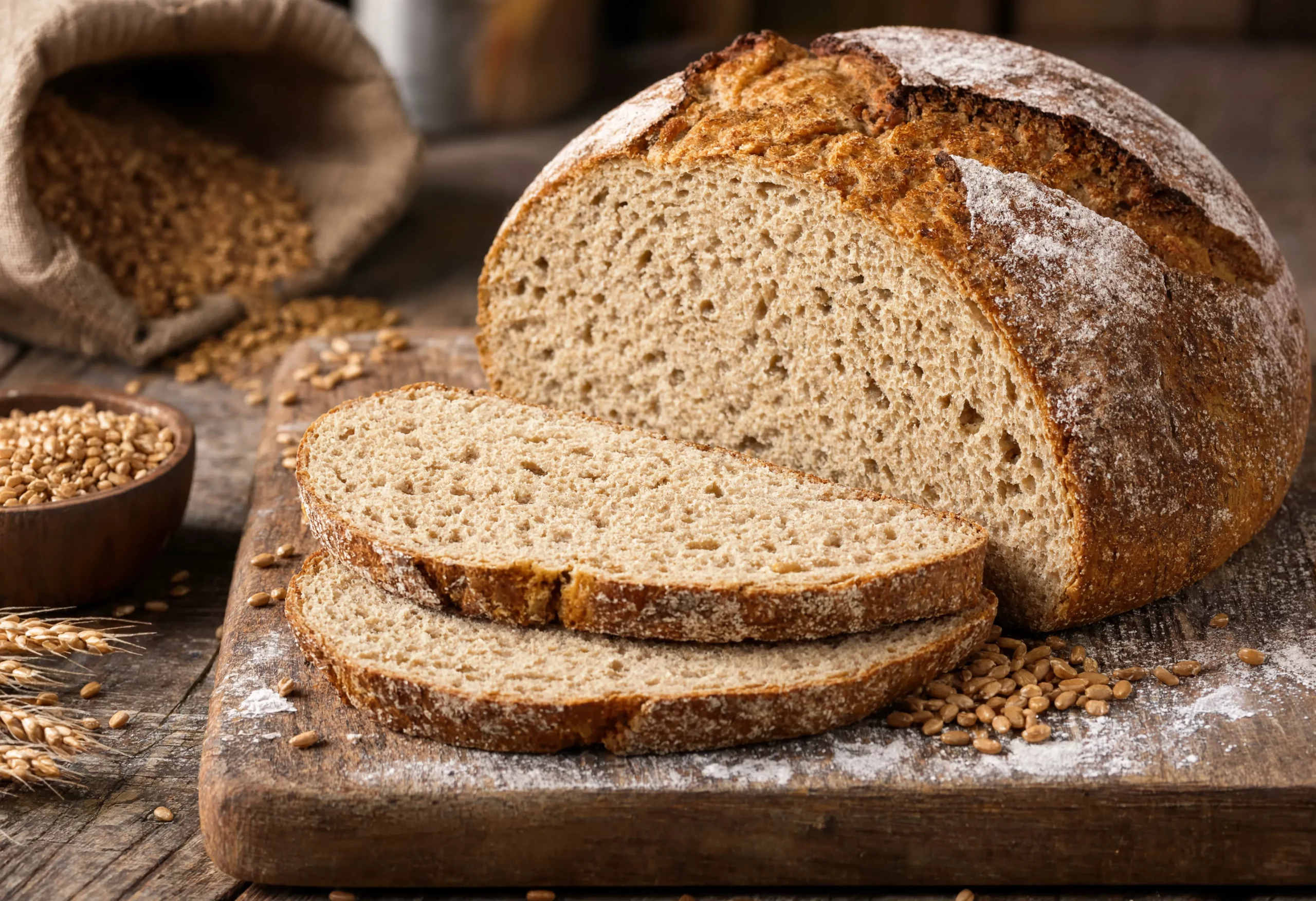
Artisan and commercial bakers rely on this same principle when specifying whole wheat and specialty wheat fractions for bread production. The protein content and gluten strength of a given wheat lot determine crumb structure, crust development, and shelf stability, which is why bakeries sourcing at volume request the same lot-level documentation that a snack food processor would demand of specialty corn.
Waxy corn’s functional properties in food texture applications depend on its starch composition, specifically the ratio of amylopectin to amylose. Standard moisture content and physical hardness parameters required for optimal dry milling of specialty corn varieties must be verified through lot-specific Certificate of Analysis documentation, as these parameters are not uniform across growing seasons or geographic origins. Manufacturers who specify waxy corn for starch-intensive applications, such as retort-stable sauces, frozen food matrices, or confectionery coatings, need supplier documentation that goes beyond a generic grain spec sheet.
Specialty Grains in Beverage Production
Commercial brewers and craft producers use specialty grains in two distinct ways: as malted base grains that provide fermentable sugars, and as specialty additions, steeped or mashed, to contribute color, flavor, and body without meaningfully increasing fermentable sugar content. Steeping specialty grains, meaning soaking crushed grain in hot water before the main mash, extracts soluble compounds including melanoidins, dextrins, and roasted flavor precursors that define a beer’s sensory profile. Specific malts carry precise functional signatures: biscuit malt delivers a warm, toasted aroma and golden color, a de-husked dark malt adds deep color and smooth roasted character without the harsh bitterness that husked dark malts can introduce, and a Munich-style malt enhances body, malt aroma, and deep amber color.
Maintaining lot-level traceability for these malts is the mechanism that ensures batch-to-batch consistency. For brewers requiring verified non-GMO status, identity-preserved handling programs provide the documented chain of custody that PCR verification alone cannot establish.
Dry-milled specialty corn produces brewers grits, which function as adjuncts in commercial brewing by contributing clean fermentable sugars and body stability without introducing off-flavors. For clean-label beers, brewers require strict variety segregation and PCR verification to confirm non-GMO status, a requirement that extends to every ingredient in the grain bill, not just the base malt. Every shipment should be accompanied by a Certificate of Analysis verifying food-grade specifications including moisture content, foreign material limits, and mycotoxin levels.
Common brewing grain categories and what each contributes to a finished beer:
Biscuit-style malt: provides a warm, toasted aroma and golden color, used in ales, lagers, and amber styles.
De-husked dark malt: adds deep dark color and smooth roasted flavor without harsh bitterness, suited for dark lagers, stouts, and porters.
Munich-style malt: enhances body, malt aroma, and deep amber color, a foundational malt in Marzen and bock styles.
Brewers grits: derived from dry-milled specialty corn, providing clean fermentable sugars and body stability as a brewing adjunct.
Specialty Grains for Animal Feed and Industrial Uses
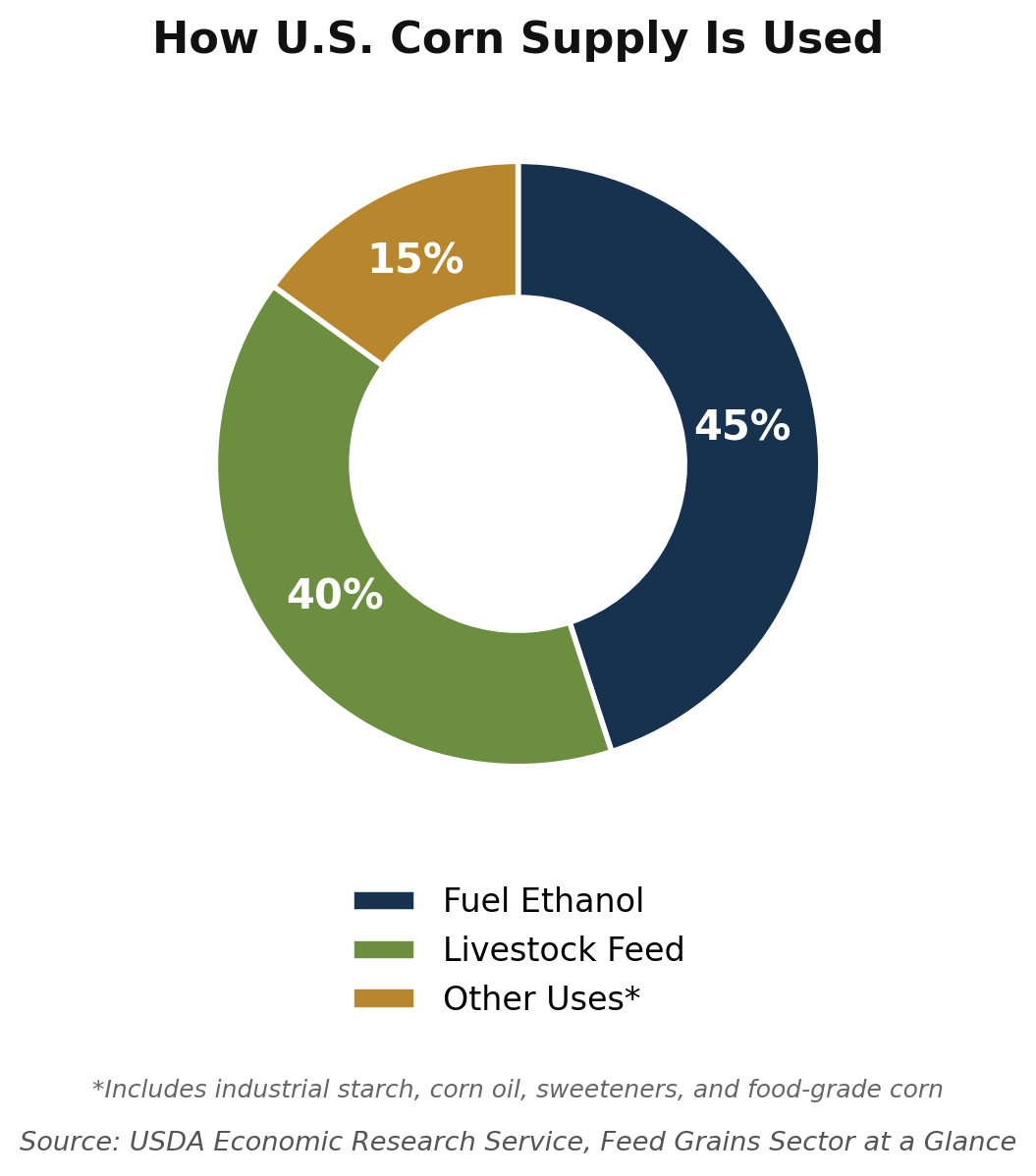
Corn’s dominance in the feed grain sector reflects its energy density and processing versatility. Corn accounts for over 95 percent of total feed grain production and use in the United States, with livestock feed representing approximately 40 percent of total domestic corn consumption, serving as the primary energy ingredient for cattle, hogs, and poultry. Sorghum, barley, and oats fill specific niches in feed formulations where regional availability or nutritional profiles make them preferable to corn, but none approaches corn’s scale in the domestic market.
On the industrial side, wet milling of corn produces industrial starch, industrial alcohol, and fuel ethanol, with fuel ethanol now accounting for nearly 45 percent of total corn use in the U.S. Agricultural feedstocks and processing byproducts are also the subject of active research for biochemical conversion into bio-based products, including bio-based plastics and surfactants, as renewable alternatives to environmentally persistent industrial polymers. For high-volume processors and industrial manufacturers, supply chain reliability is non-negotiable, since even short delays can halt a production run. Contracted bulk grain programs secure annual volume with full lot traceability and flexible shipping options built in.
How Buyers Choose the Right Grain Type
When to Source Specialty Grains From a Dedicated Supplier
The decision to source specialty grains from a dedicated supplier rather than a commodity channel comes down to whether your process can tolerate the variability that commodity channels introduce. If your formulation depends on a specific starch profile, a certified non-GMO status, or a documented lot history for regulatory compliance, commodity grain cannot meet that requirement by definition.
Ancient grains vs. specialty grains: Ancient grains such as amaranth, quinoa, teff, millet, and buckwheat have remained largely unchanged for millennia and carry distinct nutritional profiles valued in health-oriented consumer products. Specialty grains such as white, blue, pink, or waxy corn and specific wheat fractions are selected or bred for defined functional properties and produced at commercial scale for manufacturing applications. The sourcing requirements, certification pathways, and processing infrastructure for each category differ substantially.
Functional properties: Evaluate starch profiles (amylose versus amylopectin ratios), kernel hardness (flint versus dent), and protein content relative to your process requirements. Moisture content and physical hardness parameters for optimal dry milling of specialty corn varieties must be verified via lot-specific Certificate of Analysis documentation, since these figures vary by variety and season.
Certifications: Verify USDA Organic, SQF, Kosher, and non-GMO Project Verified status before contracting. Each certification carries its own audit trail and documentation requirements that must align with your compliance obligations.
Every shipment from a qualified supplier should include a Certificate of Analysis confirming food-grade specifications and lot traceability, not as a courtesy, but as a baseline condition of purchase.
Sourcing from central Nebraska, where the Ogallala aquifer supports consistent irrigation for specialty crops, functions like using a centralized logistics hub. It enables efficient nationwide distribution via truckload, tote, and rail while reducing the geographic variability that affects grain quality in more climatically exposed regions. A commitment to sustainable, well-managed farmland reflects the operational reality that long-term supply reliability depends on the agronomic health of the land producing the grain, not just the equipment that processes it afterward.
Frequently Asked Questions
What are specialty grains?
Specialty grains are crops with specific genetic, physical, or chemical traits grown for defined end-use applications rather than bulk commodity markets. Examples include yellow, white, blue, pink, and waxy corn varieties, each with distinct starch profiles and pigment characteristics, as well as high-value wheat fractions developed for vital gluten production, high-selenium bran, or whole white wheat applications. Unlike commodity grains priced on volume, specialty grains carry value tied to variety purity, certification status, and documented processing performance.
What is the difference between ancient grains and specialty grains?
Ancient grains, including quinoa, amaranth, teff, millet, and buckwheat, have remained genetically stable for thousands of years and are valued primarily for their nutritional density and consumer recognition in health-oriented markets. Specialty grains, by contrast, are selected or bred for specific functional properties, such as waxy corn’s amylopectin-dominant starch profile, blue corn’s natural pigments, or specific wheat varieties’ gluten strength in tortilla applications. The distinction matters for procurement because the two categories occupy different supply chains, certification frameworks, and processing infrastructure.
How are specialty grains used in commercial food manufacturing?
Food manufacturers use specialty grains through two primary processing pathways. Dry milling produces flour, grits, and meal for snacks, cereals, and baked goods, and requires specific kernel hardness at intake. Wet milling yields starches, oils, and syrups, including high fructose corn syrup and industrial starch, for a wider range of food and industrial applications. Every shipment entering a food manufacturing facility should include a Certificate of Analysis verifying food-grade specifications before it reaches the production floor.
Why are specialty malts used in brewing?
Specialty malts provide color, flavor, and body characteristics that base malts cannot deliver on their own. Steeping specialty grains extracts soluble compounds, including melanoidins, dextrins, and roasted flavor precursors, that define a beer’s sensory profile without adding significant fermentable sugars. A Munich-style malt builds amber color and malt body, a de-husked dark malt delivers color and smooth roast character without bitterness, and a biscuit-style malt contributes toasted aroma and golden color. For IPAs and other hop-forward styles, specialty malts provide the malt backbone that balances bitterness and supports head retention.
What are the benefits of sourcing specialty grains from a certified supplier?
Certified suppliers reduce procurement risk across three dimensions: quality consistency, audit-ready compliance, and supply chain transparency. USDA Organic, SQF, and Non-GMO Project Verified certifications provide documented assurance that the grain meets your label claims, but only if the supplier maintains variety segregation and lot traceability through the entire supply chain. Proactive mycotoxin testing is another critical differentiator, since suppliers who test every lot and provide results with the Certificate of Analysis give buyers the documentation needed for regulatory compliance and internal quality audits. The grain’s physical and chemical traits determine your product’s performance, while the supplier’s documentation practices determine your compliance posture.
Choosing a specialty grain supplier is a risk management decision as much as a procurement one. Clark Specialty Grains has operated from Gothenburg, Nebraska, since 2003, building a supply chain centered on food-grade specifications, lot traceability, and Certificate of Analysis verification for every shipment. The operational discipline that identity preservation requires, including variety segregation, documented chain of custody, and certified testing, is what separates a supplier who can substantiate your label claims from one who can only approximate them.
Ready to secure a supply of identity-preserved, food-grade grains? Contact our team to discuss your contract requirements, or learn more about Clark Specialty Grains and the varieties currently available.
Choosing the wrong partner costs more than a bad quote. A rejected shipment, whether flagged for mycotoxin exceedance, missing lot documentation, or a failed non-GMO verification, can halt a production line for days and trigger downstream costs that dwarf the original ingredient price. That is why how to compare grain suppliers is not a pricing exercise. It is a risk-management exercise, and for procurement managers and QA directors sourcing at commercial volumes, getting it right the first time is measurable in dollars and production hours.
Unit price is a data point, not a decision criterion. A supplier quoting a few cents less per bushel who cannot furnish a Certificate of Analysis with every lot, cannot demonstrate lot traceability, or cannot coordinate freight to your facility’s receiving dock is not actually cheaper. The hidden cost simply surfaces later, usually at the worst possible moment. This guide breaks the evaluation into a repeatable framework so your team can normalize supplier quotes, verify compliance claims, and make a sourcing decision that holds up under audit.
How to Compare Grain Suppliers Across Four Core Pillars
Procurement teams evaluating bulk grain suppliers need a multi-criteria model that captures both quantitative performance metrics and qualitative operational standards. Anchoring on unit price is a natural instinct, but it consistently underweights the services embedded in a well-structured supplier relationship, including freight coordination, Certificates of Analysis, certification portfolios, and the administrative capacity to respond to a regulatory inquiry within a single business day. A dependable framework evaluates every candidate against the same four pillars: product fit, compliance documentation, logistics capability, and operational responsiveness.
Product fit is the first filter, and it is more precise than most buyers initially account for. Grains are a foundational component of the food supply chain, and matching the right classification to your formulation directly determines operational efficiency and regulatory standing, according to the USDA Food Buying Guide. Whole grains retain the bran, germ, and endosperm, while enriched grains are modified to restore vitamins and minerals under FDA Standards of Identity, and each carries distinct labeling and documentation obligations. Buyers supplying federal Child Nutrition Programs work against a precise threshold: at least 80 percent of weekly grains must qualify as whole grain-rich, meaning the product contains between 50 and 100 percent whole grain.
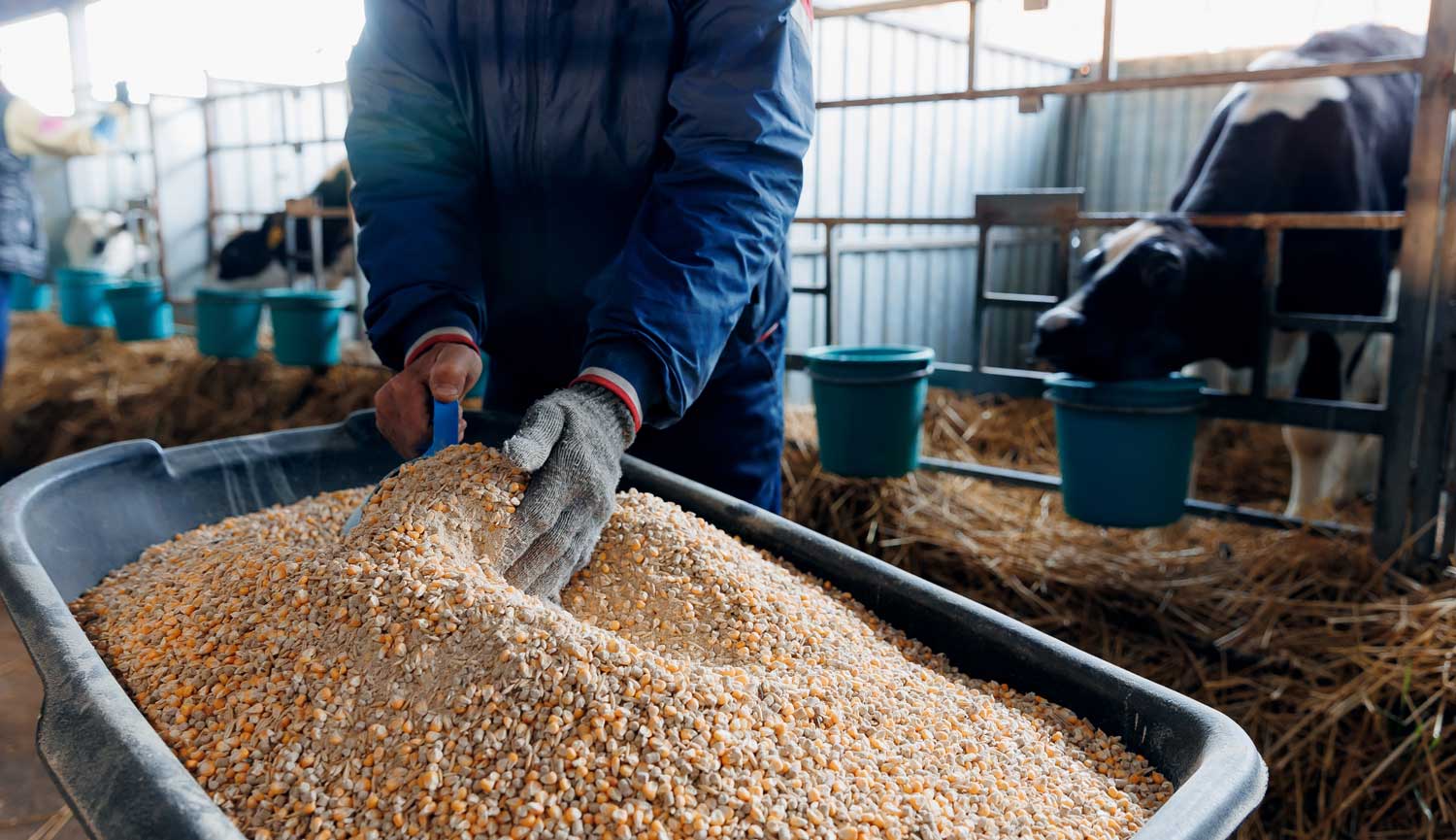
Process-specific classifications add another layer. Nixtamalized corn products, including hominy, corn masa, and masa harina, are classified as whole grains because the alkaline cooking process enhances nutrient bioavailability, which affects both formulation compliance and label claims. Feed-grade corn and food-grade corn are frequently priced from the same commodity pool, but they are not interchangeable specifications. The image below shows raw corn being measured for feed use, a reminder that a supplier’s ability to segregate food-grade grain quality standards from feed-grade commodity handling is one of the first things worth confirming before a contract is signed.
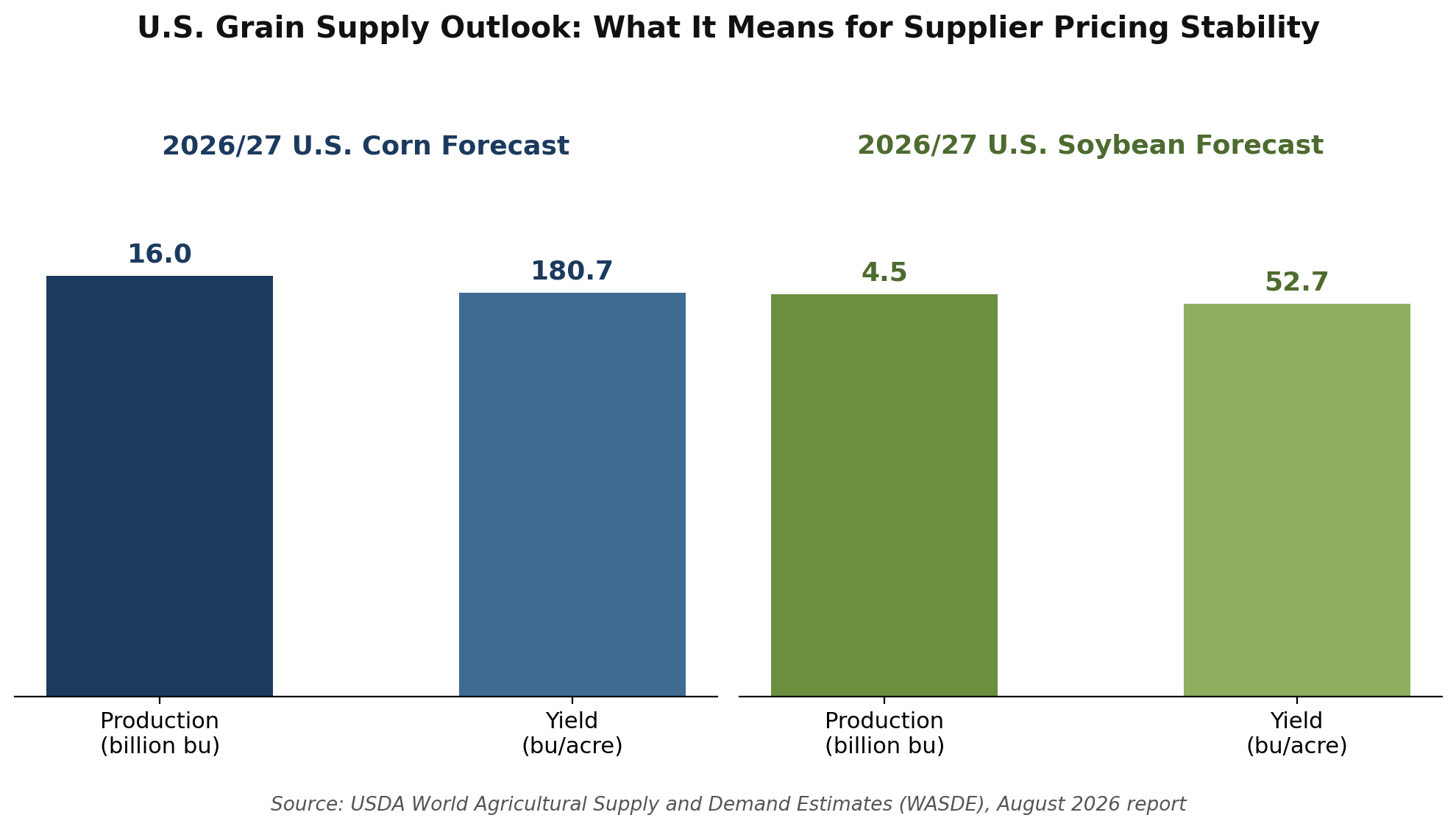
Macro-level supply conditions belong in the evaluation too, since domestic availability directly shapes a supplier’s ability to hold pricing and honor contracted volumes. For the 2026/27 crop year, the USDA projects a near-record U.S. corn harvest of 16.0 billion bushels at an average yield of 180.7 bushels per acre, alongside a soybean harvest of 4.5 billion bushels at 52.7 bushels per acre, per the USDA WASDE report. A supplier worth contracting with should be able to explain how favorable harvest projections translate into pricing stability and inventory commitments for their partners, not just quote a spot price and move on.
Quality and Safety Standards to Verify Before You Sign
Meeting food-grade quality standards requires more than sourcing from a bonded elevator. Physical parameters, including moisture content, test weight, foreign material percentage, and kernel damage, must be measured against your specific tolerances and backed by documented testing, not verbal assurance. A supplier who cannot provide lot-level data on these parameters before shipment is asking you to absorb risk that should be theirs to carry.
Contamination control is where the gap between commodity suppliers and food-grade specialists becomes most apparent. Mycotoxin testing, including aflatoxin and vomitoxin limits, should be standard on every commercial lot. For non-GMO programs, PCR testing to verify genetic purity is non-negotiable, since identity-preserved claims mean little without the analytical verification behind them. For organic shipments specifically, ask about pest-prevention treatments during transit and storage. Carbon dioxide treatment eliminates live insects without leaving chemical residue, which matters considerably when an organic certification is on the line.
Physical specifications: Confirm the grain meets your exact tolerances for moisture, foreign material, and kernel damage before any contract is signed.
Testing protocols: Every shipment should arrive with a Certificate of Analysis documenting active mycotoxin testing and genetic purity verification.
Pest prevention: Suppliers handling organic loads should offer carbon dioxide treatment as a standard option, not an upcharge.
Chain of custody: Strict variety segregation and documentation are essential whenever a retail label carries a non-GMO or single-variety claim.
A Practical Framework for How to Compare Grain Suppliers on Documentation
When comparing grain sourcing partners, documentation is the only instrument available to verify what the industry calls credence attributes, such as organic certification, non-GE status, and fair-trade sourcing, qualities that cannot be detected through physical testing of the finished product. For complex or blended grain products, a supplier must be able to furnish a Product Formulation Statement or a Child Nutrition label demonstrating that the weight of whole grains equals or exceeds the weight of enriched grains. If a supplier cannot produce these documents on request, the claim on the label is unverifiable, and that liability transfers to you the moment the product ships.
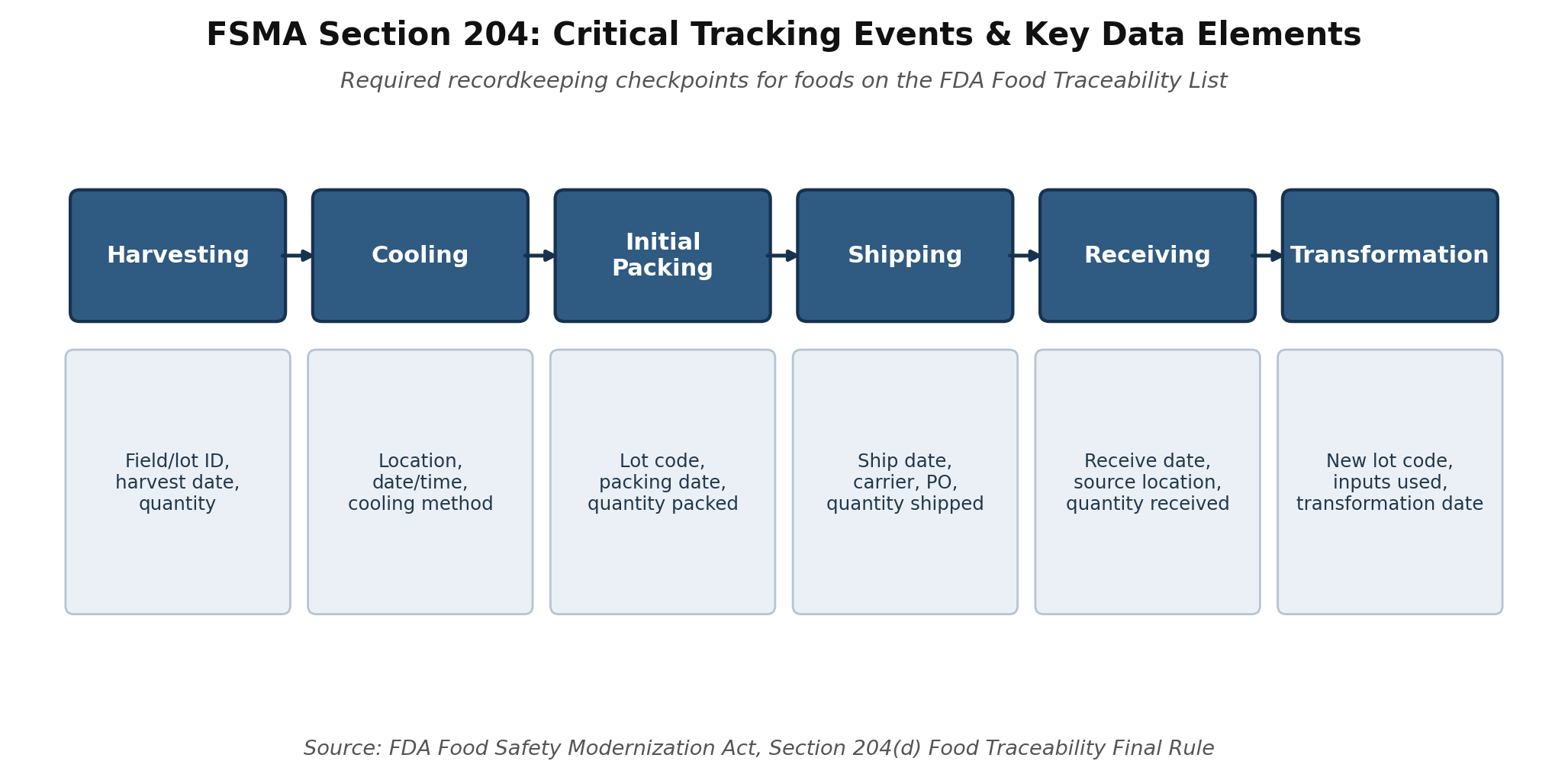
The regulatory stakes around documentation have sharpened considerably. Under Section 204 of the FDA Food Safety Modernization Act, traceability has moved from a voluntary quality practice to a mandatory compliance requirement for foods on the Food Traceability List. Suppliers handling these foods must maintain records of Key Data Elements for specific Critical Tracking Events, spanning harvesting, cooling, initial packing, shipping, receiving, and transformation, and must maintain a formal traceability plan specifying recordkeeping formats, food identification procedures, and lot code assignment methodology, according to the FDA Food Safety Modernization Act. A supplier who cannot describe their traceability plan in concrete terms is not yet operating at the compliance level the rule demands.
Sourcing genetically verified grain also requires strict PCR-verified documentation at every lot level to protect a retail label claim. Ask any candidate non-GMO grain program to walk you through their lot-level verification records before you sign, rather than accepting a general certification on faith.
Traceability: The Measurable Difference Between Suppliers
Reputable suppliers share a structural commitment to operational consistency, documented risk management, and transparent communication, not as marketing posture but as operational necessity. A reliable partner will carry third-party certifications, such as SQF, Kosher, and Gluten-Free, that provide independent validation of a facility’s safety standards. These certifications represent audited systems a supplier must maintain year over year, and they give your QA team a defensible basis for approving a new source.
Traceability infrastructure is where operational reliability becomes measurable rather than promotional. Expert consensus in agricultural supply chain research holds that traceability systems cannot function as standalone quality tools. They must be integrated with active quality control, real-time delivery tracking, and safety management frameworks to deliver genuine commercial and public health value, per the USDA Economic Research Service. Electronic tracking technologies, including barcodes and radio-frequency identification, are central to streamlining supply chains, reducing distribution overhead, and enabling automated inventory management.
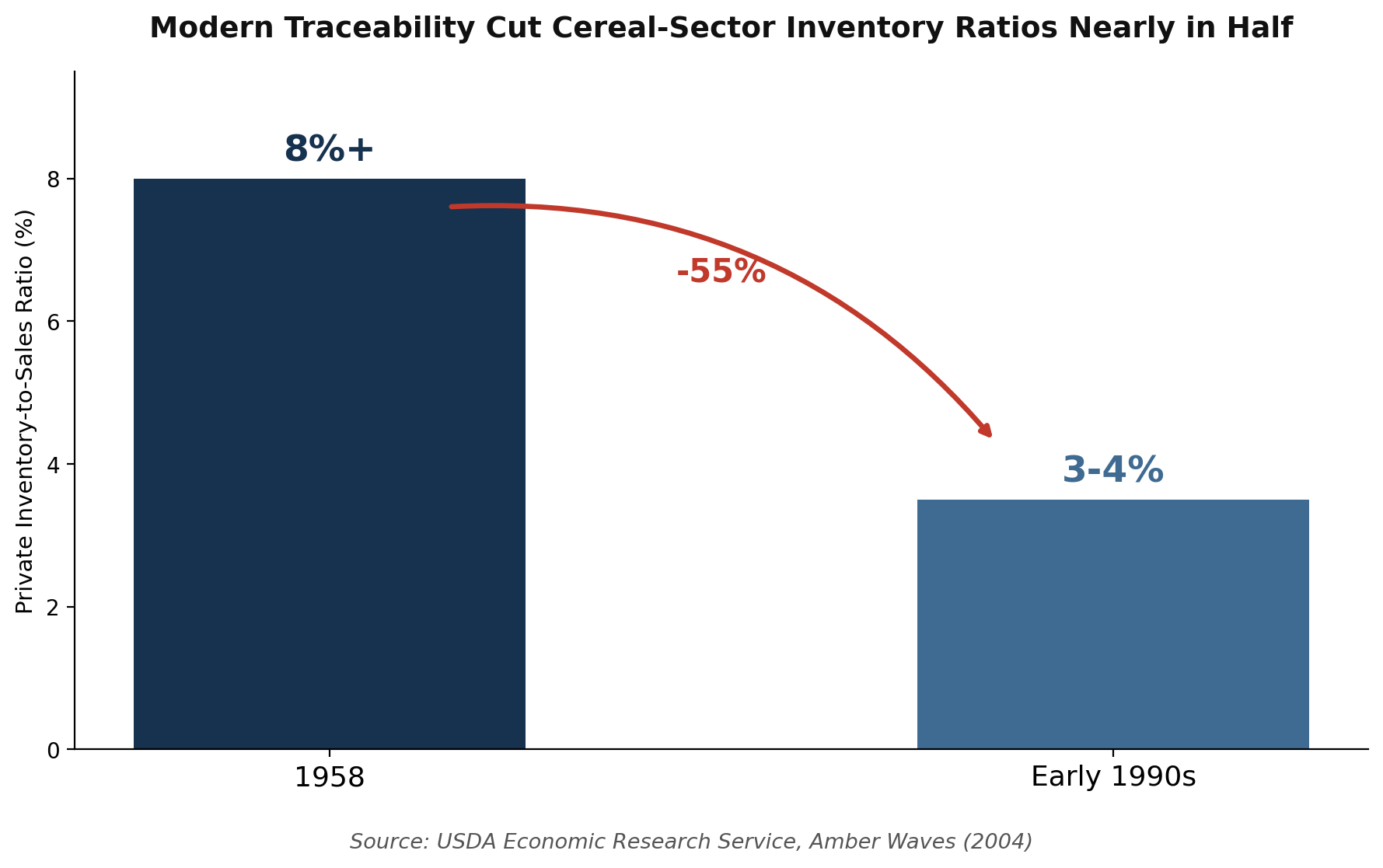
The operational payoff of mature traceability infrastructure is well documented. Modern supply chain tracking drove a significant reduction in private inventory-to-sales ratios across the cereal sector, which fell from more than 8 percent in 1958 to 3 to 4 percent by the early 1990s, enabling leaner operations and automated reordering for buyers. For procurement teams managing tight production schedules, a supplier with real-time inventory visibility translates directly into reduced safety stock requirements on your end.
A supplier’s traceability framework can be assessed across three dimensions: breadth, meaning the scope of information captured; depth, meaning how far upstream or downstream the system can trace a lot; and precision, meaning the degree of confidence in pinpointing a product’s movement at any given point. Lot traceability works like a manufacturing batch number. Every truckload can be traced back to its field, harvest date, and certification documents, the same way a food processor tracks a lot of finished product. When evaluating a new supplier, ask for a walkthrough of their lot traceability system. A supplier who cannot answer specific questions about Critical Tracking Events or lot code assignment is unlikely to meet your audit requirements.
Third-party certifications: SQF, Kosher, and Gluten-Free certifications verify facility safety through independent annual audits.
Electronic traceability: Suppliers using modern lot-tracking systems provide rapid data access and support automated inventory management.
Standardized recordkeeping: Look for structured frameworks that track grain movement from the field through every handling event to your receiving dock.
Operating history: A farming operation with a verifiable, multi-generation history of supply chain reliability carries a different risk profile than a brokerage assembled last season.
When to Choose a Specialty Grain Partner Over a Commodity Elevator
Not every sourcing requirement can be satisfied by a commodity elevator. The scenarios below indicate that a specialty grain partner, specifically one with dedicated identity-preservation infrastructure, third-party certifications, and process-specific expertise, is the right call.
Strict genetic purity: When your product requires PCR-verified non-GMO sourcing or specific hybrid genetics to meet manufacturing specifications, a commodity channel cannot provide the chain-of-custody documentation your QA program requires.
Organic integrity: When you require USDA Organic certification with a dedicated organic system plan to prevent commingling. Under NOP regulation Section 205.201, the plan must describe the specific management practices and physical barriers used to prevent commingling of organic and nonorganic products on a split operation, per the USDA Organic Handbook. A dedicated organic grain certification program should be able to produce that plan on request.
Custom processing: When your formulation demands specialized handling, such as nixtamalization, custom milling, or specific color profiles like blue, pink, waxy, or flint corn, the supplier needs direct processing capability, not just sourcing access.
Preserved identity: When your retail label depends on single-variety or non-GMO claims, look for a partner running dedicated identity-preserved handling protocols, since shared equipment and inconsistent clean-out procedures put those claims at risk.
Logistics capability deserves the same scrutiny as quality documentation. Grain suppliers operate within an integrated multimodal transportation network of trucks, barges, rail, and ocean vessels, and transportation efficiency is a primary driver of delivered cost competitiveness, particularly when offsetting domestic land and labor costs, according to the USDA Agricultural Transportation office. Shipping rates fluctuate with diesel fuel prices, barge rates, rail bids, and fuel surcharges, which means a supplier’s freight capability is not static. It requires active management. Global disruptions compound this dynamic, since conflict around the Sea of Azov and Black Sea has constrained grain exports from Russia and Ukraine, reinforcing the case for sourcing from a partner with resilient, diversified domestic multimodal shipping capability.
Grain Supplier Evaluation Checklist
Use the scorecard below to normalize quotes across every candidate before you compare a single price. A supplier who cannot check most of these boxes is not actually competing on the same terms as one who can.
Evaluation Pillar
What to Ask For
Product fit
Exact grain classification, moisture and test weight specs, and available color or variety profiles matched to your formulation
Compliance documentation
Certificate of Analysis per lot, PCR verification for non-GMO claims, and a written traceability plan citing Critical Tracking Events
Certifications
SQF, Kosher, Gluten-Free, and USDA Organic system plan documentation where applicable
Logistics
Truckload, tote, and rail delivery options, plus a track record of on-time performance during peak freight season
Responsiveness
A documented process for answering a regulatory or recall inquiry within 24 hours
Frequently Asked Questions
What food safety and cleaning standards should I expect from a commercial grain supplier?
A reputable commercial supplier should maintain active quality control and grain safety testing protocols, including multi-stage cleaning to remove foreign material, regular mycotoxin testing covering aflatoxin and vomitoxin limits, and protective treatments such as carbon dioxide to prevent pest infestation during transit and storage. Facility certifications, such as SQF, Kosher, or Gluten-Free, provide third-party verification that these systems are audited and maintained rather than simply claimed.
How do suppliers handle the risk of GMO contamination in non-GMO grain shipments?
Reliable suppliers use strict identity-preserved protocols and variety segregation, which means dedicated handling equipment, documented clean-out procedures between runs, and PCR testing to verify genetic purity before shipment. Every non-GMO lot should be accompanied by documentation tracing the grain from the originating field through each handling event to delivery. Verbal assurance is not a substitute for PCR verification records.
What documentation should organic grain shipments include on a split operation?
Under NOP regulation Section 205.201, suppliers operating split operations must document the specific management practices and physical barriers used to prevent commingling of organic and nonorganic products. This includes equipment clean-out procedures, transportation unit clean-out documentation, and physical inspection records at organic control points. Ask for a copy of the supplier’s organic system plan and confirm it addresses each of these elements explicitly.
How quickly must a supplier respond to a traceability request during a recall?
Under the FDA Food Traceability Rule, suppliers handling foods on the Food Traceability List must be able to provide required traceability records, specifically an electronic sortable spreadsheet, within 24 hours of a request during an outbreak or recall. A supplier who cannot demonstrate that their recordkeeping infrastructure supports that response window is a liability in your supply chain, regardless of price.
When does the FDA Food Traceability Rule become mandatory?
Congressional directives have delayed mandatory enforcement of the Food Traceability Rule until July 20, 2028, giving firms additional time to establish compliance readiness. That deadline is closer than it appears for operations that have not yet built the required recordkeeping infrastructure. Choosing a supplier who already operates at that compliance standard reduces your own transition risk considerably.
Evaluating and selecting a grain supplier requires a methodical approach that holds quality, compliance documentation, and logistics capability to the same standard. A supplier who excels on one dimension but falls short on another creates a gap your QA team will eventually have to close, usually under time pressure. Establishing a contracted program with an audit-ready partner, one who can furnish a Certificate of Analysis with every lot, maintain lot traceability from seed to shipment, and respond to a regulatory inquiry within 24 hours, is the most direct path to supply chain resilience.
Since 2003, Clark Specialty Grains has operated as a third-generation farming and processing operation specializing in food-grade corn and specialty grains, with complete lot-level traceability, SQF compliance, and documentation-backed quality at every stage. Ready to put this framework to work? Contact our team to request a Certificate of Analysis, discuss your specifications, or establish a contracted sourcing program.
For food manufacturers, ingredient processors, and other large-volume buyers, choosing the right non-GMO grain supplier involves more than finding an available crop at an acceptable price. Procurement and quality teams should evaluate how grain is grown, segregated, tested, documented, stored, and transported before approving a supplier.
That level of diligence is particularly important for corn. Genetically engineered varieties account for the large majority of U.S. corn acreage, which makes segregation and documented sourcing controls important for buyers making non-GMO commitments. At Clark Specialty Grains, we structure our grain programs around the specifications and documentation requirements established with each customer.
Key Sourcing Takeaways
Choose a qualified non-GMO grain supplier: Look for documented sourcing controls, appropriate testing, lot-level traceability, and clear procedures for preventing commingling.
Understand testing protocols: Ask which testing methods are used, where samples are taken, which traits are tested, and what action thresholds apply to your program.
Verify physical segregation: Review storage, processing, loading, and equipment cleanout practices instead of relying on verbal assurances.
Require useful documentation: Determine which Certificates of Analysis, PCR test results, traceability records, certifications, and shipping documents your quality team needs before ordering.
Evaluate identity preservation: Identity-preserved programs can provide additional traceability and varietal control when those characteristics matter to your product.
Questions to Ask a Non-GMO Grain Supplier
A supplier evaluation should start with specific questions about sourcing and verification rather than price alone. The appropriate testing program can vary according to the crop, intended use, certification program, customer requirements, and type of claim a manufacturer plans to make.
Ask prospective suppliers questions such as:
What non-GMO sourcing requirements do you establish with growers?
What testing methods are used for the grain we are buying?
Does an accredited third-party laboratory perform the testing?
At what points in the supply chain is testing conducted?
Is documentation tied to individual lots?
How do you prevent commingling with genetically engineered or other grain?
What happens when a test result does not meet the customer’s specification?
Can you provide sample documentation before we approve the supplier?
Our non-GMO grain supply programs are built around verified sourcing controls, segregated handling, PCR-based laboratory testing, lot-level traceability, and documentation tailored to customer requirements.
Understand What the 0.9% Threshold Actually Means
One important correction to common discussions about non-GMO sourcing involves the 0.9% figure. The Non-GMO Project uses a 0.9% action threshold for products intended for human consumption. It should not be described as a universal U.S. legal limit for every food ingredient or every non-GMO claim.
An action threshold is also not the same thing as permission to intentionally use genetically engineered material up to that percentage. It is designed to address inadvertent or technically unavoidable presence within the requirements of the applicable verification standard. Buyers should therefore determine which certification, customer standard, contract specification, or labeling requirement governs their own product.
PCR-based testing is commonly used in non-GMO verification because it detects genetic material associated with genetically engineered traits. Depending on the method and sample, quantitative PCR can estimate the proportion of targeted genetic material in a sample. It is more accurate to describe PCR results as quantitative measurements or estimates under a defined analytical method rather than claiming that they reveal an exact percentage under every circumstance.
Compare PCR Testing With Rapid Strip Testing
PCR and lateral-flow strip testing serve different purposes. Rapid strips generally detect particular proteins associated with genetically engineered traits and can be useful for screening crops in the field or at receiving points. PCR testing detects DNA rather than expressed proteins and can provide more detailed information when quantitative analysis is required. Neither method should automatically be described as universally superior without considering the crop, processing level, intended claim, and verification standard.
Testing Method
What It Detects
Best Used For
Limitation
PCR (Polymerase Chain Reaction)
DNA associated with genetically engineered traits
Quantitative lab analysis and lot-specific verification
Can be difficult on heavily processed ingredients with degraded DNA
Rapid Strip (Lateral Flow)
Proteins associated with genetically engineered traits
Field screening and receiving-point checks
Qualitative only, not designed for precise percentage estimates
Manufacturers should ask suppliers for enough information to understand the following:
Whether testing is qualitative or quantitative
Which genetic traits or events are included
How samples are collected
Which laboratory performs the analysis
Whether the method is appropriate for the grain and processing stage
How results are associated with shipment lot numbers
Heavily processed ingredients create an additional challenge because processing can degrade or remove DNA. In those situations, documentation from earlier stages of the supply chain may become especially important.
Review Segregation and Equipment Cleanout Procedures
A compliant test result is only useful if the grain remains properly controlled afterward. Grain can pass through harvesting equipment, trucks, bins, conveyors, processing systems, storage areas, and loading equipment before reaching a manufacturer’s facility.
When non-GMO and other grain share infrastructure, documented cleanout and segregation procedures become important. Buyers should determine how the supplier controls each transfer point rather than assuming that “non-GMO” means every piece of equipment is permanently dedicated.
Questions worth asking include:
Are storage bins dedicated or shared?
If equipment is shared, what cleaning procedures are followed between lots?
How is cleanout completion documented?
Are trucks or railcars inspected before loading?
How are lot identities maintained during processing and transfer?
What safeguards prevent the wrong grain from entering a non-GMO lot?
For programs requiring tighter varietal control, our identity-preserved grain programs maintain segregation and lot-level traceability from seed selection through delivery.
Require Documentation That Matches Your Quality Program
What a Non-GMO Grain Supplier Should Document
There is no single document package that every non-GMO purchaser must receive. The correct documentation depends on contractual requirements, certification programs, downstream customer expectations, and the manufacturer’s own quality system.
A supplier’s documentation package may include:
A Certificate of Analysis
PCR or other laboratory test results
Lot identification and traceability records
Supplier or grower non-GMO declarations
Organic certificates when applicable
Identity preservation documentation
Bills of lading and shipping records
Customer-specific compliance documentation
The important point is that records should correspond to the material being purchased and be detailed enough for a buyer’s quality team to verify compliance with its own requirements.
Unsupported non-GMO claims can create real problems, but that does not mean every shipment is legally required to have a lot-specific PCR Certificate of Analysis. U.S. law does not impose one universal documentation package for all voluntary non-GMO claims. In a 2015 investigation involving Xochitl corn chips, however, the FTC concluded that the company lacked a reasonable basis for its “No GMO” claims when it had not specifically requested non-GMO corn or obtained adequate evidence from suppliers. Consumer Reports testing cited by the FTC found an average of more than 75% GMO corn content in six tested packages. The FTC ultimately did not recommend enforcement action after the company removed the claim and implemented additional sourcing and testing measures. See the FTC’s closing letter on the Xochitl non-GMO labeling investigation for the complete agency record.
Understand USDA Organic Versus Non-GMO Verification
USDA Organic and third-party non-GMO verification are related but distinct standards. USDA organic regulations prohibit the intentional use of excluded methods, including genetic engineering, in certified organic production and handling. Organic operations also take measures designed to avoid unintended contact with prohibited materials.
However, USDA Organic is fundamentally a process-based certification. USDA policy makes clear that the inadvertent presence of detectable genetically engineered material does not by itself mean an organic product violates the regulations. Organic certification therefore should not be described as a guarantee of absolute zero GMO presence.
Standard
What It Governs
GMO Approach
Guarantees Zero GMO Presence?
Non-GMO Project Verified
Voluntary non-GMO labeling standard
0.9% action threshold for inadvertent presence
No, threshold-based
USDA Organic
Federal organic production and handling regulations
Prohibits intentional use of genetic engineering
No, process-based; inadvertent presence alone does not void certification
Likewise, Non-GMO Project Verified products are not automatically organic. A non-GMO crop may be produced using conventional agricultural practices that would not satisfy USDA Organic requirements. For manufacturers that need certified organic grain in addition to non-GMO controls, we offer food-grade grain programs that can be structured around the appropriate certification, testing, and documentation requirements.
Evaluate Food-Grade Quality Alongside Non-GMO Status
Non-GMO status is only one component of ingredient suitability. A manufacturer also needs grain that meets the physical, food-safety, processing, and performance specifications established for its product.
Food-grade corn specifications may consider factors such as moisture, test weight, kernel condition, varietal purity, color, foreign material, mycotoxin results, processing characteristics, and required certifications. Yellow, white, blue, pink, and other specialty corn varieties can perform differently depending on milling, cooking, extrusion, nixtamalization, or other manufacturing processes. Procurement teams should therefore evaluate the entire product specification rather than treating non-GMO status as a substitute for food-grade quality standards. Our approach includes multi-stage cleaning, segregation, testing, and pre-shipment documentation for programs that require food-grade specialty grain.
Consider Supply Capacity and Logistics
A technically strong non-GMO program still has to supply the volume a manufacturer needs on schedule. Procurement teams should evaluate inventory strategy, grower relationships, storage capacity, contracted production options, packaging formats, transportation access, and contingency planning.
Questions to discuss include:
Can the supplier support spot and contracted purchases?
How early should specialty varieties be contracted?
Which packaging formats are available?
Can the supplier coordinate full truckload and rail shipments?
What happens when crop conditions reduce availability?
Can specifications be maintained consistently across multiple deliveries?
Our bulk grain supply capabilities include 50-pound bags, 2,000-pound totes, bulk hopper trailers, and railcar shipments, depending on the grain, volume, and customer program, with rail logistics coordinated through access to Union Pacific and BNSF networks. For specialty crops with limited acreage, early planning is especially useful. Contracted programs can help align grower production with a manufacturer’s anticipated purchasing requirements, although contract terms, pricing structures, and availability should always be evaluated for the individual program.
Know the Limitations of Non-GMO Testing
No single laboratory result can replace good supply-chain controls. Testing verifies the sample examined under the analytical method used. It does not independently prove what happened at every point from planting through delivery.
Sampling is particularly important because a laboratory analyzes only a portion of a larger lot. Buyers should understand how representative samples are collected and how the supplier responds when results fall outside an agreed specification. Highly refined or processed ingredients may contain little intact DNA, which can make certain PCR analyses difficult or inconclusive. The FTC’s Xochitl letter, for example, specifically noted that its cited laboratory used a comparative approach designed to account for DNA degradation in processed corn chips.
For these reasons, strong programs combine appropriate testing with sourcing controls, segregation, traceability, and documentation instead of treating one PCR result as proof of the entire supply chain.
Build a Non-GMO Grain Program Around Your Specifications
Clark Specialty Grains works with food manufacturers, ingredient processors, distributors, and other commercial buyers that need documented specialty grain programs. Our offerings include non-GMO, USDA-certified organic, identity-preserved, food-grade, and specialty corn programs, with yellow, white, blue, pink, and other grain options available depending on crop-year supply.
Our facility supports third-party certification and quality programs, including SQF, Kosher, and Gluten Free certifications, along with PCR verification through accredited third-party laboratories, and we offer bulk shipping in bags, totes, hopper trailers, and railcar quantities.
If you are reviewing an existing supplier or developing a new sourcing program, we can discuss the grain variety, volume, testing scope, certifications, documentation, packaging, and transportation requirements that matter to your operation. Contact our grain sourcing team to discuss availability, request documentation, or begin building a program.
Frequently Asked Questions About Sourcing Non-GMO Grains
What should I ask a non-GMO grain supplier before ordering?
Ask about grower requirements, testing methods, sampling, segregation procedures, equipment cleanout, lot traceability, available certifications, documentation, shipping procedures, and how out-of-spec results are handled.
Is 0.9% the legal U.S. limit for non-GMO food?
No. The 0.9% figure is an action threshold used by the Non-GMO Project for products intended for human consumption. It is not a universal federal limit governing every voluntary non-GMO claim.
Does USDA Organic mean a product is guaranteed to contain zero GMO material?
No. USDA Organic prohibits the intentional use of genetic engineering, but the organic rules are process-based. Unintended detectable GMO presence alone does not automatically cause a product to lose organic status when the certified operation has complied with its required practices.
Why is PCR testing used for non-GMO verification?
PCR testing detects targeted DNA sequences and can be used to identify or quantify genetically engineered material when sufficient analyzable DNA is present. The appropriate method depends on the commodity, processing stage, verification program, and customer requirements.
What is identity preserved grain?
Identity preservation is a controlled system for maintaining the identity and characteristics of a grain lot through segregation, tracking, and documentation. An identity preservation program may be especially valuable for specialty varieties, non-GMO programs, and other products where traceability is important.
Do all non-GMO shipments legally require a Certificate of Analysis?
No universal federal rule requires every voluntary non-GMO grain shipment to include the same Certificate of Analysis or PCR documentation. Manufacturers should establish documentation requirements based on their contracts, certifications, customer expectations, labeling claims, and internal quality systems.
How can cross-contact occur during grain transportation?
Residual grain can remain in trucks, trailers, railcars, bins, conveyors, and other equipment. Inspection, cleaning, segregation, lot controls, and appropriate documentation help reduce the risk of unintended commingling.
Choosing the right organic grain supplier starts long before a purchase order is signed. It starts with verifying current USDA organic certification, confirming exactly which grains and activities that certification covers, and evaluating whether a supplier’s documentation, testing, and handling systems actually match what your production program requires. A supplier that looks solid on price can still create serious problems downstream if its paperwork, traceability, or segregation practices do not hold up under audit.
Procurement managers and quality teams sourcing bulk organic grain have to manage both regulatory compliance and ingredient quality at the same time. Documentation gaps, unclear lot identification, or inadequate segregation can create complications during audits and make it harder to support organic claims all the way through the supply chain. The stakes are only getting higher: the USDA’s Strengthening Organic Enforcement rule reached full implementation on March 19, 2024, expanding certification requirements for many businesses, strengthening traceability and recordkeeping obligations, and requiring certified operations to address organic fraud risks directly in their Organic System Plans.
This guide walks through what separates a dependable organic grain supplier from one that only looks the part on paper, including certification checks, quality and handling standards, documentation, identity preservation, logistics, and the questions worth asking before a contract is signed.
How to Evaluate an Organic Grain Supplier
Evaluating an organic grain supplier should be a structured process rather than a decision based primarily on price. Start by reviewing the supplier’s organic certification, certified products and activities, quality systems, processing capabilities, traceability procedures, and transportation requirements. A supplier that cannot speak clearly to all six areas is a supplier that still needs vetting.
Certification status should also be checked periodically instead of treated as a one-time onboarding item. USDA’s Organic Integrity Database provides current information about USDA-certified organic operations, and organic operation certificates include a unique 10-digit NOP identification number issued by the certifier. Pulling that number and cross-checking it against the database takes only a few minutes and closes off one of the more common gaps in supplier files.
Quality certifications can add useful information about a supplier’s food-safety and process-control systems, but they are not a substitute for organic certification. USDA organic certification addresses organic production and handling requirements, while programs such as SQF address separate food-safety and quality-management considerations. A strong supplier file typically documents both, since they answer different questions.
Organic Grain Quality and Handling Standards
Organic certification is only one part of supplier qualification. Buyers should also examine how grain is received, stored, cleaned, tested, segregated, and prepared for shipment, since these are the steps where quality is either protected or lost.
Moisture and temperature management are especially important, because storage conditions directly affect grain stability over time. Appropriate moisture targets vary by grain, intended storage period, environmental conditions, and buyer specification, so universal moisture limits should not be treated as regulatory requirements unless they are tied to a specific applicable standard or contract.
Cleaning and conditioning equipment can also have a significant effect on finished grain quality. Screen cleaning, gravity separation, color sorting, destoning, aspiration, and metal detection all help remove foreign material, damaged kernels, and other unwanted material before food-grade grain reaches a buyer. A bulk grain supply program built around multiple stages of cleaning and quality control gives buyers a much clearer picture of what they are actually receiving.
Segregation is equally important. USDA organic regulations require certified operations to maintain organic integrity and protect organic products from commingling with nonorganic products and contact with prohibited substances. The specific procedures used to satisfy those requirements should be documented in the operation’s Organic System Plan and supporting records, not just described verbally during a sales call.
What a Reliable Organic Grain Supplier Should Provide
A qualified organic grain supplier should be able to provide documentation appropriate to the grain, certification program, buyer specification, and shipment. The exact paperwork can vary, so buyers should establish their required document package before approving a supplier rather than discovering gaps after product has already shipped.
Common records worth requesting include the following:
Organic Certification Documentation: current certification information covering the applicable operation, products, and handling activities
Lot Identification and Traceability Records: documentation connecting the grain received, processed, stored, and shipped under identifiable lots
Bills of Lading and Shipping Records: documents identifying the shipment, quantity, origin, destination, and other relevant transportation details
Certificate of Analysis: buyer-required analytical results that may include moisture, test weight, foreign material, purity, or other agreed specifications
Food-Safety Testing: testing for hazards such as mycotoxins or other contaminants where applicable, based on the grain, intended use, and buyer’s food-safety program
Non-GMO Verification: additional documentation or laboratory testing when a buyer requires a separate non-GMO claim or verification program
Not every item on this list is a universal USDA requirement for every organic shipment. Some are buyer specifications or supplier quality practices that go beyond baseline organic regulations. A strong procurement program distinguishes regulatory requirements from contractual quality requirements and documents both separately. Buyers working with food-grade grain supply programs should confirm upfront which of these records come standard and which require a specific request, and buyers who also need a documented non-GMO claim should ask how non-GMO grain verification is handled alongside organic certification, since the two programs are related but not interchangeable.
Why Identity Preservation Matters
Organic certification and identity preservation are related, but they are not the same thing. Organic certification establishes compliance with USDA organic requirements, while identity preservation focuses on maintaining the documented identity and segregation of a specific grain, variety, or lot all the way through the supply chain.
For manufacturers with precise variety, color, processing, or labeling specifications, identity preservation adds an extra layer of control that organic certification alone does not guarantee. Identity-preserved grain programs are typically built around lot-level traceability and variety segregation, which matters most for buyers running organic and non-GMO programs side by side.
Traceability also improves response time when a buyer needs to investigate a quality concern. The more precisely incoming grain can be tied to lots and supporting records, the easier it becomes to determine which material may be affected without unnecessarily involving unrelated inventory.
Certification, Traceability, and the Strengthening Organic Enforcement Rule
Agricultural products represented as USDA organic must comply with applicable USDA organic regulations. Certain operations and activities may qualify for exemptions, so it is more accurate to evaluate certification requirements based on the specific role each business performs in the organic supply chain rather than assuming a blanket rule applies to everyone.
One of the most significant changes under the Strengthening Organic Enforcement rule was expanding the number of operations that must be certified. Importing and exporting organic products are not exempt activities, while businesses that strictly transport organic products can remain exempt from certification if they perform no other handling activities. Certified operations are still responsible for maintaining records that demonstrate exempt transportation has not compromised organic status.
Date
Requirement Under the Strengthening Organic Enforcement Rule
March 19, 2024
Full implementation date. Expanded certification requirements, strengthened traceability and recordkeeping, and required organic fraud prevention measures in Organic System Plans.
March 19, 2024 forward
Organic imports generally require an electronic NOP Import Certificate generated through the Organic Integrity Database.
October 1, 2025
Imported organic shipments arriving without a valid NOP Import Certificate may no longer be reconditioned, and are instead subject to re-export, destruction, or qualifying donation.
Certified operations must also address organic fraud prevention directly in their Organic System Plans. USDA guidance on the Strengthening Organic Enforcement rule states that certified operations must maintain practices for verifying the organic status of suppliers and products and preventing organic fraud, with the scope of the plan varying according to the operation’s activities and complexity.
These changes make supplier transparency increasingly important. Buyers should know not only who sold them the grain, but also how certification and traceability are maintained through the relevant parts of the supply chain. That level of transparency is part of what buyers should expect from any organic grain supplier they intend to work with long term, and it is a standard we apply across our own nationwide grain sourcing programs.
Matching Grain Supply to Your Production Requirements
A supplier may be fully certified and still be the wrong fit for a particular manufacturing program. The grain also has to meet physical, quality, processing, and logistics specifications that are specific to your facility.
Before signing a supply agreement, establish specifications for the characteristics that matter most to your operation. Depending on the product, those typically include the items below.
Specifications to Confirm With an Organic Grain Supplier
Specification
Why It Matters
Grain variety and kernel color
Affects flavor, appearance, and labeling accuracy in finished products
Organic and non-GMO certification
Supports label claims and regulatory compliance
Moisture and test weight
Impacts storage stability and milling or processing yield
Foreign material and purity
Affects finished product quality and equipment wear
Mycotoxin requirements
Protects food-safety compliance for the finished product
Lot traceability
Speeds up investigation if a quality concern arises
Packaging format and delivery frequency
Needs to match receiving capabilities and production schedule
Annual or seasonal volume
Determines whether a supplier can support long-term contracted programs
For manufacturers using corn as a primary ingredient, organic corn variety programs covering yellow, white, blue, and pink corn can be built around organic certification, food-grade documentation, and identity-preservation options depending on the specification. Production schedules should also be discussed before a contract is finalized, since a supplier needs to understand how frequently your facility receives grain, which transportation and unloading formats it can accommodate, what documentation must arrive before or with the load, and how specification exceptions get handled when they come up.
Logistics and Freight Considerations
Organic integrity does not end when grain leaves the processing facility. Transportation procedures should be included in the supplier qualification process, because shipping creates another point where commingling, contamination, moisture exposure, or documentation problems can occur.
The Strengthening Organic Enforcement framework specifically emphasizes traceability between certified operations and requires certified businesses to demonstrate that exempt transportation activities do not compromise organic status. That does not mean federal organic rules universally mandate a document called a clean truck certificate for every load. Instead, the certified operation must have procedures and records sufficient to demonstrate that organic integrity was protected throughout transit.
Buyers can strengthen their own programs by requiring documented trailer inspections, previous-load information, cleaning records, seal numbers, bills of lading, or other controls when those measures are appropriate to their hazard analysis and supplier requirements.
Key Questions to Ask Before Choosing an Organic Grain Supplier
Before approving a supplier, it helps to ask questions that test both regulatory compliance and operational capability rather than relying on a general sales pitch:
Is your USDA organic certification current, and can I see the certificate?
Which grains and handling activities are covered by that certification?
How do you verify the certification status of growers and other upstream suppliers?
How do you identify and trace individual lots through your facility?
What segregation and equipment clean-out procedures do you use between organic and conventional runs?
What grain-cleaning and conditioning equipment is available on-site?
Which laboratory or analytical tests are routinely performed, and which are available on request?
What documentation can we receive before or with each shipment?
How are organic fraud risks addressed in your Organic System Plan?
Which transportation formats and delivery schedules can you support?
How do you handle an off-specification lot?
Can you structure a contracted program around forecasted production needs?
A dependable organic grain supplier should be able to answer these questions clearly and back up the important claims with documentation, not just a verbal assurance.
Frequently Asked Questions
What is the National Organic Program?
The National Organic Program is administered by the USDA Agricultural Marketing Service and establishes the federal standards governing agricultural products represented as organic in the United States.
How do I verify an organic grain supplier’s certification?
Review the supplier’s current organic certificate and check the operation in USDA’s Organic Integrity Database. Organic operation certificates contain a unique 10-digit NOP identification number that can help identify the certified operation.
Does every organic grain shipment require a Certificate of Analysis?
USDA organic regulations do not impose a universal requirement that every organic grain shipment include a Certificate of Analysis. However, many food manufacturers require lot-specific analytical documentation as part of their own supplier quality programs.
What is chain of custody in organic grain sourcing?
Chain of custody refers to documentation showing how a product moves through relevant parties in the supply chain. Strong traceability records allow certified operations and buyers to connect physical grain with the records supporting its origin, organic status, handling, and movement.
What is the difference between quality assurance and quality control?
Quality assurance focuses on the systems used to prevent problems, such as supplier approval, sanitation procedures, certification verification, and traceability. Quality control focuses more directly on measuring or inspecting the grain itself, such as checking moisture, test weight, foreign material, or other specifications.
Does an organic grain transporter have to be USDA-certified organic?
A business that strictly transports organic products and performs no other handling activities can be exempt from organic certification. Certified operations must still maintain records demonstrating that transportation did not compromise the organic status of the product.
Are organic import certificates required?
With limited exceptions, organic agricultural products imported into the United States must be associated with an electronic NOP Import Certificate issued through the Organic Integrity Database by an appropriate certifier.
Choose an Organic Grain Supplier That Can Support Your Quality Program
Choosing an organic grain supplier requires more than comparing price per bushel. Certification status, traceability, handling controls, testing, logistics, communication, and documentation all affect how reliably grain moves into a production program without creating downstream problems.
Clark Specialty Grains supplies certified organic corn in yellow, white, blue, and pink varieties and sources additional organic and specialty grain species according to crop-year availability, supported by documented processing and quality systems across organic, non-GMO, identity-preserved, and food-grade programs. If you need to evaluate grain availability, certification requirements, specifications, or contracted volumes, connect with our grain sourcing team to discuss your program and request the documentation you need before making a purchasing decision.
Organic non-GMO corn is used across a wide range of food and ingredient applications, from tortilla chips and cereals to cornmeal, snack products, baking mixes, and specialty foods. For manufacturers, brands, distributors, and ingredient buyers, selecting the right corn is about more than choosing a color or kernel type. Buyers must also evaluate certifications, traceability, food safety practices, processing capabilities, product consistency, and the supplier’s ability to support long-term ingredient programs. As consumer interest in recognizable ingredients, organic agriculture, and non-GMO products continues to influence purchasing decisions, certified corn can help food companies meet specific product standards while supporting clear and credible label claims.
Common Uses for Organic Non-GMO Corn
Organic corn that has not been genetically modified can be processed into numerous food ingredients and finished products. Its exact use depends on the corn variety, kernel characteristics, color, flavor, texture, moisture level, and milling or processing method.
Food manufacturers may purchase whole-kernel corn for in-house processing or source corn that has been cleaned, sorted, milled, cracked, or otherwise prepared for a specific production process. The best format depends on the manufacturer’s equipment, recipes, production volume, and finished-product requirements.
What Makes Organic Non-GMO Corn Different?
The terms “organic” and “non-GMO” describe related but distinct product attributes. Understanding the difference is important when evaluating ingredients and supplier documentation.
Certified organic corn must be grown and handled according to applicable organic standards. Organic production standards generally prohibit the use of genetically engineered seeds and place restrictions on most synthetic pesticides, fertilizers, and other agricultural inputs. Organic certification also requires documented practices, inspections, and controls throughout the supply chain.
Non-GMO corn is produced without genetically modified seed varieties. Depending on the buyer’s requirements, non-GMO status may be supported through supplier declarations, identity-preserved production systems, testing programs, third-party verification, or a combination of these methods.
Organic corn is inherently non-GMO under organic production standards, but buyers may still request additional non-GMO documentation or testing. This is especially common when manufacturers have strict customer specifications, retailer requirements, export obligations, or third-party verification programs.
Organic non-GMO corn may also differ from conventional commodity corn in how it is managed after harvest. Food-grade and specialty corn programs often involve additional controls for:
Seed selection
Field history and production practices
Buffer zones or isolation from neighboring crops
Harvest timing
Cleaning and drying
Dedicated or carefully managed storage
Transportation
Lot identification
Testing and documentation
These controls help preserve the identity, quality, and certification status of the grain from the farm through delivery.
Food Applications for Organic Corn Products
Organic corn is highly versatile because it can be processed in several ways. Each processing method produces different functional characteristics, textures, and flavor profiles.
Tortillas and tortilla chips: Food-grade corn is commonly cooked through nixtamalization, a traditional process that uses water and an alkaline ingredient such as lime. The cooked corn is then processed into masa for tortillas, chips, tostadas, and related products. Yellow and white corn are widely used, while blue and other specialty colors can create distinctive premium products.
Cornmeal and corn flour: Milled organic corn is used in cornbread, muffins, pancakes, coatings, baked goods, and gluten-free formulations. Particle size can influence texture, moisture absorption, mixing performance, and finished-product consistency.
Grits and polenta: Coarsely ground corn is used in traditional grits, polenta, side dishes, prepared meals, and foodservice products. Buyers may specify color, granulation, cooking time, and flavor characteristics.
Breakfast cereals: Organic corn may be used in flakes, puffs, crisps, extruded cereals, and multigrain blends. Cereal manufacturers often require consistent kernel properties to support predictable processing and finished-product texture.
Snack foods: Corn serves as a base for chips, curls, puffs, crackers, and extruded snacks. Different corn varieties and milling specifications can affect expansion, crunch, density, flavor, and appearance.
Gluten-free foods: Corn is naturally gluten-free, making it a common ingredient in products designed for consumers avoiding gluten. However, manufacturers must still evaluate cross-contact risks throughout farming, storage, transportation, milling, and packaging if they plan to make a gluten-free claim.
Specialty and premium foods: Blue, purple, pink, white, and other specialty corn varieties can help brands develop products with distinctive colors, regional stories, and premium market positioning. These varieties may be used in chips, tortillas, cereals, baked goods, meal kits, and chef-inspired products.
Brewing and fermentation: Some food and beverage producers use corn as a fermentable grain or adjunct. Buyers sourcing for fermentation should discuss starch characteristics, moisture, microbial specifications, and processing needs with the supplier.
Why Food Manufacturers Choose Certified Corn
Food manufacturers choose certified organic and non-GMO corn for several reasons. In many cases, the decision is driven by a combination of consumer expectations, brand positioning, retailer requirements, product claims, and internal ingredient policies.
One of the primary advantages is documentation. Certification creates a structured system for verifying how the crop was produced, handled, and tracked. This can make it easier for manufacturers to support package claims and respond to customer or auditor requests.
Maintain traceability from production through processing
Differentiate products through specialty colors and varieties
Strengthen consumer confidence in ingredient sourcing
Align sourcing programs with sustainability goals
Prepare for third-party audits or customer reviews
Certification alone does not guarantee that every lot will perform identically in a food production environment. Manufacturers must still evaluate physical quality, food safety, functionality, and consistency. A strong supplier should be able to discuss both certification status and practical product performance.
Buyers should also distinguish between food-grade corn and general commodity corn. Food-grade programs typically place greater emphasis on kernel appearance, purity, cleanliness, moisture, test weight, defect levels, storage practices, and processing suitability. The exact requirements vary by application.
For example, a tortilla manufacturer may prioritize cooking performance, masa yield, color consistency, and kernel hardness. A snack producer may focus on expansion, particle size, texture, and oil absorption. A cereal manufacturer may require precise moisture, starch, and physical specifications. The ideal corn is the one that consistently performs within the buyer’s process.
Sourcing Organic Corn for Ingredient Programs
Sourcing organic corn for a commercial ingredient program requires planning. Buyers should begin by defining the application, annual volume, preferred variety, quality specifications, certification requirements, delivery schedule, and testing expectations.
Agricultural ingredients are affected by crop cycles, weather, regional growing conditions, harvest quality, storage capacity, and market demand. Specialty varieties may have more limited availability than standard yellow or white corn. Buyers who need specific colors, varieties, or volumes should communicate forecasts as early as possible.
Consistency is especially important for manufacturers operating high-volume production lines. Variations in moisture, kernel size, hardness, color, or foreign material can affect milling, cooking, extrusion, mixing, and finished-product quality. Buyers should work with suppliers that understand how agricultural variability can influence processing.
The supplier’s storage and handling practices are also critical. Even high-quality corn can be compromised by poor drying, pest activity, moisture migration, cross-contact, or inadequate sanitation. Buyers should ask how grain is received, cleaned, stored, monitored, sampled, tested, and released.
Long-term supplier relationships can provide additional benefits. A supplier that understands the manufacturer’s application may be better positioned to recommend appropriate varieties, anticipate seasonal needs, communicate crop conditions, and address specification changes.
Supplier Questions for Organic and Non-GMO Buyers
Before approving a supplier, buyers should ask detailed questions about production, certification, quality, and logistics. The answers can help determine whether the supplier is equipped to support a commercial food ingredient program.
Important questions include:
Is the corn certified organic, and can you provide a current certificate?
How is non-GMO status verified?
Is the grain produced through an identity-preserved program?
What corn varieties and colors are available?
Is the product intended and managed for food-grade use?
What cleaning, sorting, and handling steps are performed?
What are the standard specifications for moisture, foreign material, defects, and test weight?
Are certificates of analysis available by lot?
What testing is performed for mycotoxins, pesticide residues, pathogens, or other contaminants?
How is lot traceability maintained?
How are organic and non-organic grains segregated?
What controls are used to reduce cross-contact during storage and transportation?
Can the supplier support contracted volumes or scheduled releases?
What happens if a lot does not meet the agreed specification?
Are food safety audits or third-party certifications available?
How does the supplier monitor stored grain quality?
Can the supplier support specialty varieties consistently from season to season?
Buyers should document agreed requirements before placing large orders. A written specification can reduce misunderstandings and provide a clear standard for quality review. Specifications may include physical characteristics, microbiological limits, chemical limits, sensory expectations, certifications, packaging, labeling, shelf life, and storage conditions.
Manufacturers should also conduct production trials before making significant formulation or sourcing changes. A sample may look acceptable in a laboratory but perform differently during cooking, milling, extrusion, or large-scale production. Trials allow the buyer to evaluate yield, flavor, color, texture, handling, and finished-product stability.
Buyer Considerations for Specialty Corn Varieties
Specialty corn can create meaningful product differentiation, but each variety may have unique sourcing and processing considerations. Blue, purple, pink, white, and yellow corn can differ in flavor, pigmentation, kernel hardness, availability, and end-use performance.
Color is often a major purchasing factor. Natural pigmentation can help manufacturers create visually distinctive chips, tortillas, cereals, snacks, and baked goods. However, final product color may be influenced by cooking conditions, pH, heat exposure, milling, ingredient interactions, and storage.
Buyers should not assume that all corn of the same color will perform the same way. Variety, growing region, harvest conditions, and handling practices can affect the grain. Manufacturers should evaluate representative samples and establish acceptable color ranges when visual consistency is important.
Volume planning is another key consideration. Specialty corn may be grown under contract or produced in smaller quantities. Manufacturers with substantial annual requirements should discuss acreage, crop planning, storage, and forecast commitments with suppliers well before the desired delivery period.
Sustainability may also influence supplier selection. Buyers can ask about soil management, crop rotation, water use, farm relationships, waste reduction, transportation efficiency, and long-term agricultural practices. Organic certification provides a defined production framework, but manufacturers may have additional sustainability goals that require deeper supplier engagement.
Frequently Asked Questions
Is organic corn always non-GMO?
Certified organic corn must be produced without genetically engineered seed. Buyers may still request separate testing, identity-preservation documentation, or third-party non-GMO verification based on their product requirements.
What products are commonly made with organic non-GMO corn?
Common products include tortillas, tortilla chips, cornmeal, corn flour, grits, polenta, breakfast cereals, extruded snacks, baking mixes, coatings, and specialty foods.
What is food-grade corn?
Food-grade corn is grown, handled, stored, and evaluated for human food applications. It generally must meet defined standards for cleanliness, defects, moisture, purity, safety, appearance, and processing performance.
Is organic corn naturally gluten-free?
Corn is naturally gluten-free. Manufacturers making gluten-free claims must also manage the risk of cross-contact with wheat, barley, rye, or other gluten-containing grains throughout the supply chain.
What is the difference between yellow, white, and blue corn?
The varieties differ in pigmentation, flavor, appearance, kernel characteristics, availability, and potential processing performance. The best choice depends on the intended product and desired sensory profile.
Can organic corn be purchased in bulk?
Yes. Suppliers may offer bulk truckload quantities, totes, bags, or other formats. Available options depend on the supplier, product type, order volume, and customer requirements.
Should buyers request a certificate of analysis?
A certificate of analysis can provide useful lot-specific information. Buyers should determine which tests and specifications are necessary for their application and confirm the supplier’s standard testing program.
How should manufacturers evaluate an organic corn supplier?
Why is traceability important when sourcing organic corn?
Traceability helps connect each shipment to its production, storage, handling, and testing records. It supports certification compliance, quality investigations, audit readiness, and effective lot management.
When should buyers begin planning for specialty corn purchases?
Planning should begin as early as possible, particularly for large volumes or less common colors and varieties. Early forecasts can help suppliers plan production, storage, and delivery more effectively.
Source Organic and Non-GMO Corn From Clark Specialty Grains
Choosing the right corn supplier is essential for maintaining product quality, supporting label claims, and building a dependable ingredient program. We are a premier non-GMO corn and grain supplier serving food-industry buyers nationwide.
As a family-owned business with more than 18 years of experience, we are committed to delivering high-quality organic and non-GMO corn varieties for commercial food applications. Our dedication to excellence, sustainability, quality, and safety has helped us earn a reputation as a trusted source of food-grade corn.
We offer a diverse range of specialty corn varieties, including yellow, white, blue, purple, and pink corn. Whether you are sourcing premium blue corn for tortilla chips, white corn for masa products, colored corn for a specialty snack, or another grain for your ingredient program, our team is ready to help you identify products that align with your specifications and production needs.
Contact us to learn more and discuss your organic, non-GMO, food-grade corn and specialty grain sourcing requirements.