
How to Compare Grain Suppliers: A Sourcing Guide for Commercial Buyers
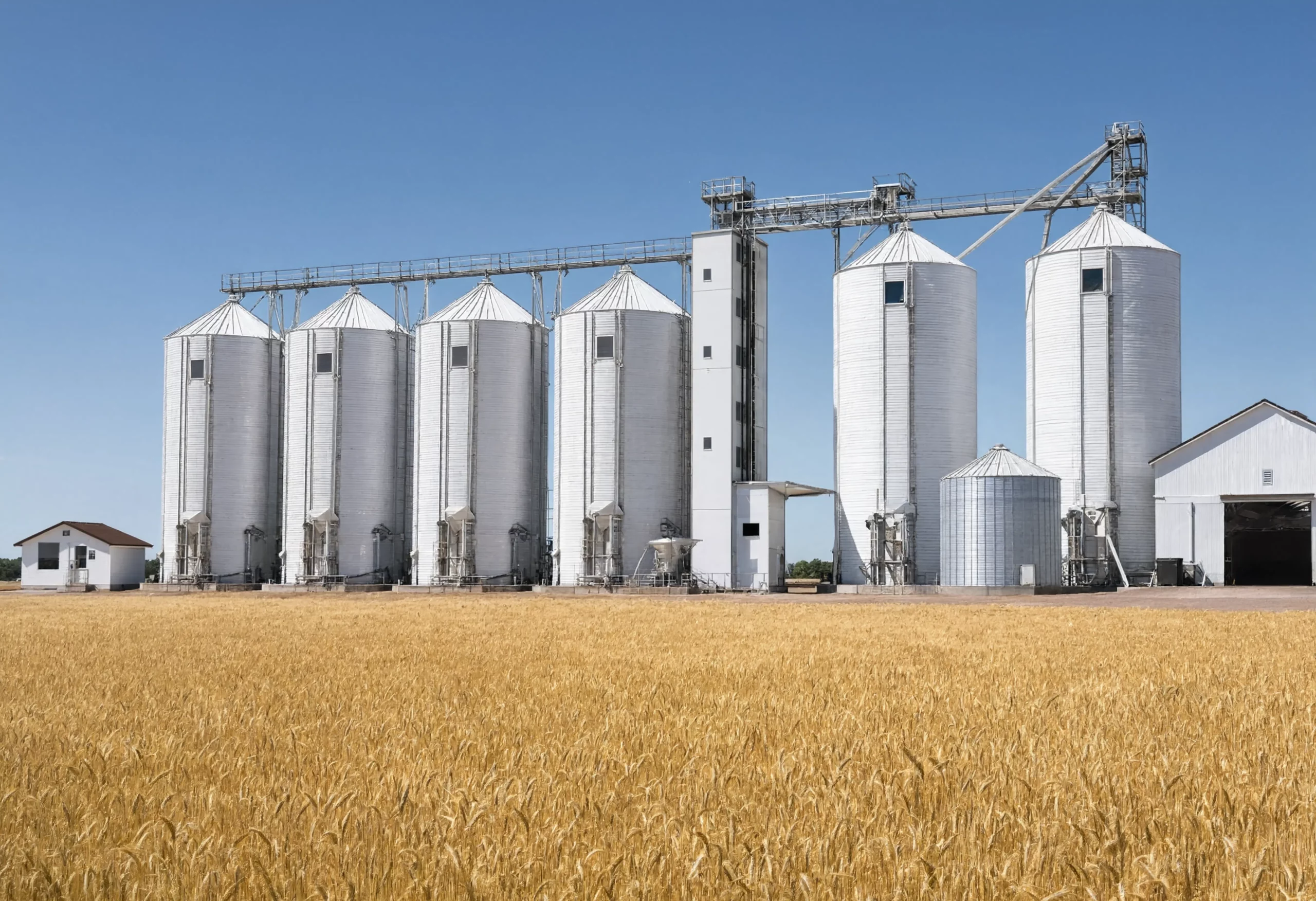
Choosing the wrong partner costs more than a bad quote. A rejected shipment, whether flagged for mycotoxin exceedance, missing lot documentation, or a failed non-GMO verification, can halt a production line for days and trigger downstream costs that dwarf the original ingredient price. That is why how to compare grain suppliers is not a pricing exercise. It is a risk-management exercise, and for procurement managers and QA directors sourcing at commercial volumes, getting it right the first time is measurable in dollars and production hours.
Unit price is a data point, not a decision criterion. A supplier quoting a few cents less per bushel who cannot furnish a Certificate of Analysis with every lot, cannot demonstrate lot traceability, or cannot coordinate freight to your facility’s receiving dock is not actually cheaper. The hidden cost simply surfaces later, usually at the worst possible moment. This guide breaks the evaluation into a repeatable framework so your team can normalize supplier quotes, verify compliance claims, and make a sourcing decision that holds up under audit.
How to Compare Grain Suppliers Across Four Core Pillars
Procurement teams evaluating bulk grain suppliers need a multi-criteria model that captures both quantitative performance metrics and qualitative operational standards. Anchoring on unit price is a natural instinct, but it consistently underweights the services embedded in a well-structured supplier relationship, including freight coordination, Certificates of Analysis, certification portfolios, and the administrative capacity to respond to a regulatory inquiry within a single business day. A dependable framework evaluates every candidate against the same four pillars: product fit, compliance documentation, logistics capability, and operational responsiveness.
Product fit is the first filter, and it is more precise than most buyers initially account for. Grains are a foundational component of the food supply chain, and matching the right classification to your formulation directly determines operational efficiency and regulatory standing, according to the USDA Food Buying Guide. Whole grains retain the bran, germ, and endosperm, while enriched grains are modified to restore vitamins and minerals under FDA Standards of Identity, and each carries distinct labeling and documentation obligations. Buyers supplying federal Child Nutrition Programs work against a precise threshold: at least 80 percent of weekly grains must qualify as whole grain-rich, meaning the product contains between 50 and 100 percent whole grain.
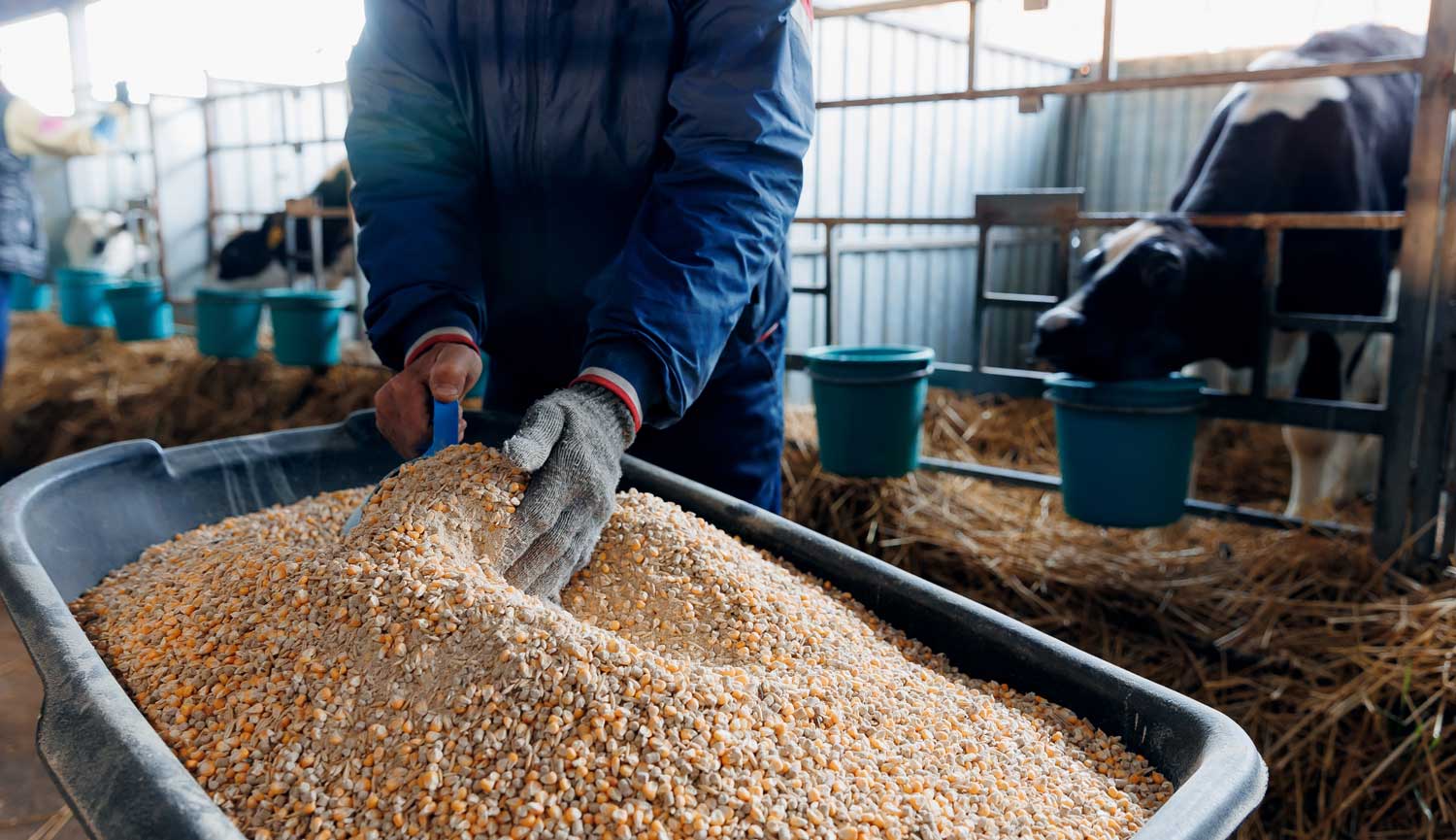
Process-specific classifications add another layer. Nixtamalized corn products, including hominy, corn masa, and masa harina, are classified as whole grains because the alkaline cooking process enhances nutrient bioavailability, which affects both formulation compliance and label claims. Feed-grade corn and food-grade corn are frequently priced from the same commodity pool, but they are not interchangeable specifications. The image below shows raw corn being measured for feed use, a reminder that a supplier’s ability to segregate food-grade grain quality standards from feed-grade commodity handling is one of the first things worth confirming before a contract is signed.
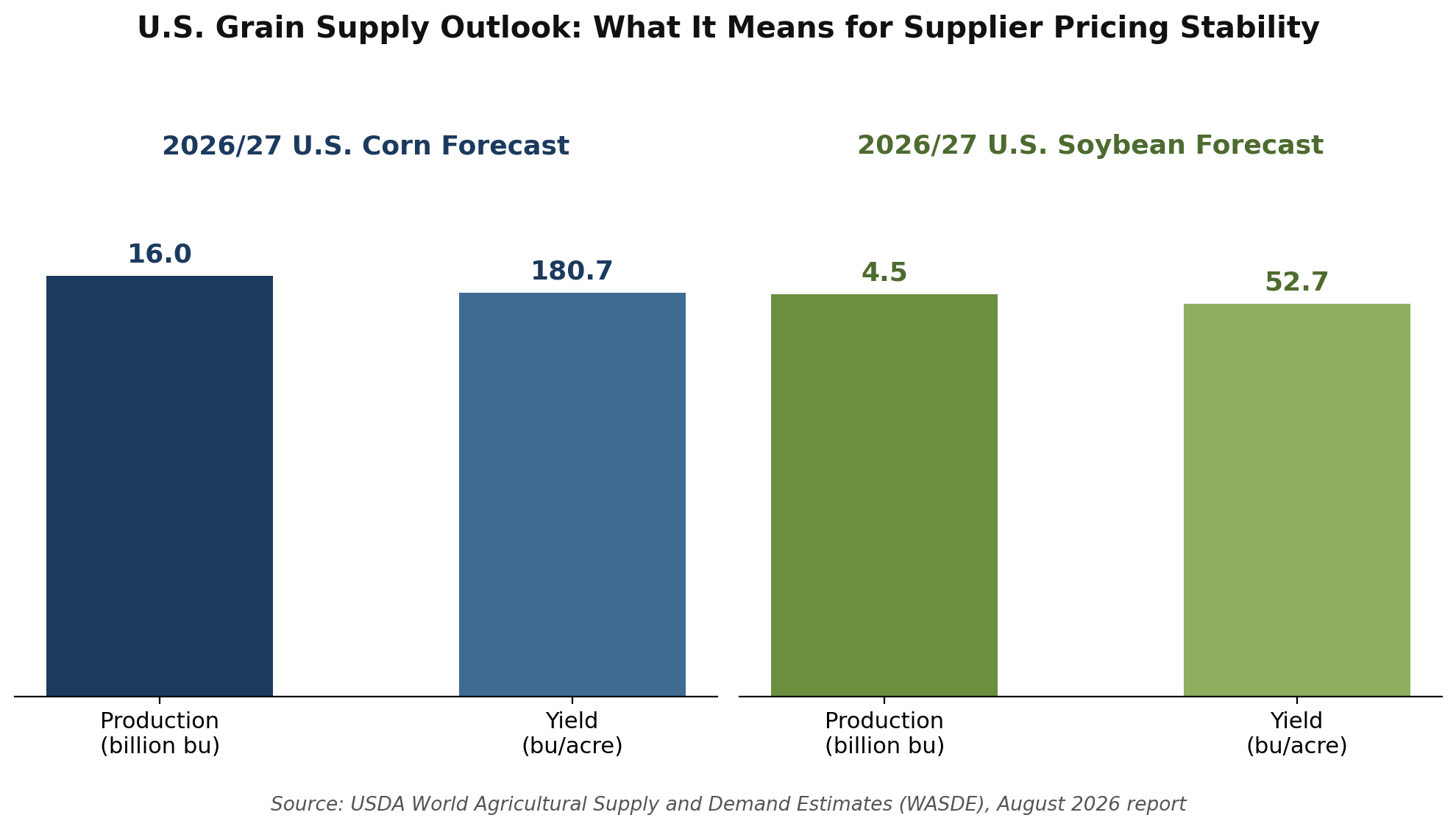
Macro-level supply conditions belong in the evaluation too, since domestic availability directly shapes a supplier’s ability to hold pricing and honor contracted volumes. For the 2026/27 crop year, the USDA projects a near-record U.S. corn harvest of 16.0 billion bushels at an average yield of 180.7 bushels per acre, alongside a soybean harvest of 4.5 billion bushels at 52.7 bushels per acre, per the USDA WASDE report. A supplier worth contracting with should be able to explain how favorable harvest projections translate into pricing stability and inventory commitments for their partners, not just quote a spot price and move on.
Quality and Safety Standards to Verify Before You Sign
Meeting food-grade quality standards requires more than sourcing from a bonded elevator. Physical parameters, including moisture content, test weight, foreign material percentage, and kernel damage, must be measured against your specific tolerances and backed by documented testing, not verbal assurance. A supplier who cannot provide lot-level data on these parameters before shipment is asking you to absorb risk that should be theirs to carry.
Contamination control is where the gap between commodity suppliers and food-grade specialists becomes most apparent. Mycotoxin testing, including aflatoxin and vomitoxin limits, should be standard on every commercial lot. For non-GMO programs, PCR testing to verify genetic purity is non-negotiable, since identity-preserved claims mean little without the analytical verification behind them. For organic shipments specifically, ask about pest-prevention treatments during transit and storage. Carbon dioxide treatment eliminates live insects without leaving chemical residue, which matters considerably when an organic certification is on the line.
- Physical specifications: Confirm the grain meets your exact tolerances for moisture, foreign material, and kernel damage before any contract is signed.
- Testing protocols: Every shipment should arrive with a Certificate of Analysis documenting active mycotoxin testing and genetic purity verification.
- Pest prevention: Suppliers handling organic loads should offer carbon dioxide treatment as a standard option, not an upcharge.
- Chain of custody: Strict variety segregation and documentation are essential whenever a retail label carries a non-GMO or single-variety claim.
A Practical Framework for How to Compare Grain Suppliers on Documentation
When comparing grain sourcing partners, documentation is the only instrument available to verify what the industry calls credence attributes, such as organic certification, non-GE status, and fair-trade sourcing, qualities that cannot be detected through physical testing of the finished product. For complex or blended grain products, a supplier must be able to furnish a Product Formulation Statement or a Child Nutrition label demonstrating that the weight of whole grains equals or exceeds the weight of enriched grains. If a supplier cannot produce these documents on request, the claim on the label is unverifiable, and that liability transfers to you the moment the product ships.
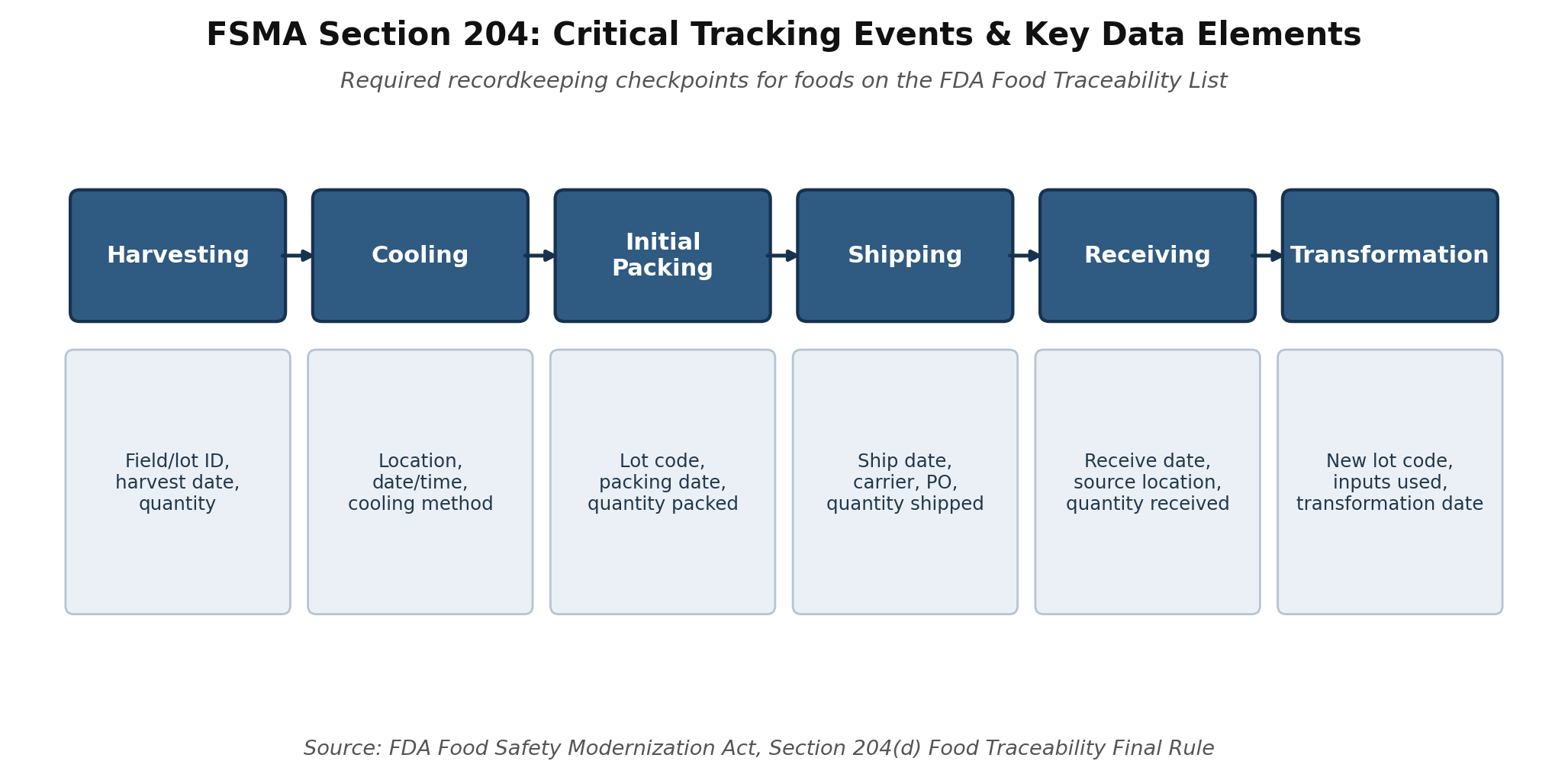
The regulatory stakes around documentation have sharpened considerably. Under Section 204 of the FDA Food Safety Modernization Act, traceability has moved from a voluntary quality practice to a mandatory compliance requirement for foods on the Food Traceability List. Suppliers handling these foods must maintain records of Key Data Elements for specific Critical Tracking Events, spanning harvesting, cooling, initial packing, shipping, receiving, and transformation, and must maintain a formal traceability plan specifying recordkeeping formats, food identification procedures, and lot code assignment methodology, according to the FDA Food Safety Modernization Act. A supplier who cannot describe their traceability plan in concrete terms is not yet operating at the compliance level the rule demands.
Sourcing genetically verified grain also requires strict PCR-verified documentation at every lot level to protect a retail label claim. Ask any candidate non-GMO grain program to walk you through their lot-level verification records before you sign, rather than accepting a general certification on faith.
Traceability: The Measurable Difference Between Suppliers
Reputable suppliers share a structural commitment to operational consistency, documented risk management, and transparent communication, not as marketing posture but as operational necessity. A reliable partner will carry third-party certifications, such as SQF, Kosher, and Gluten-Free, that provide independent validation of a facility’s safety standards. These certifications represent audited systems a supplier must maintain year over year, and they give your QA team a defensible basis for approving a new source.
Traceability infrastructure is where operational reliability becomes measurable rather than promotional. Expert consensus in agricultural supply chain research holds that traceability systems cannot function as standalone quality tools. They must be integrated with active quality control, real-time delivery tracking, and safety management frameworks to deliver genuine commercial and public health value, per the USDA Economic Research Service. Electronic tracking technologies, including barcodes and radio-frequency identification, are central to streamlining supply chains, reducing distribution overhead, and enabling automated inventory management.
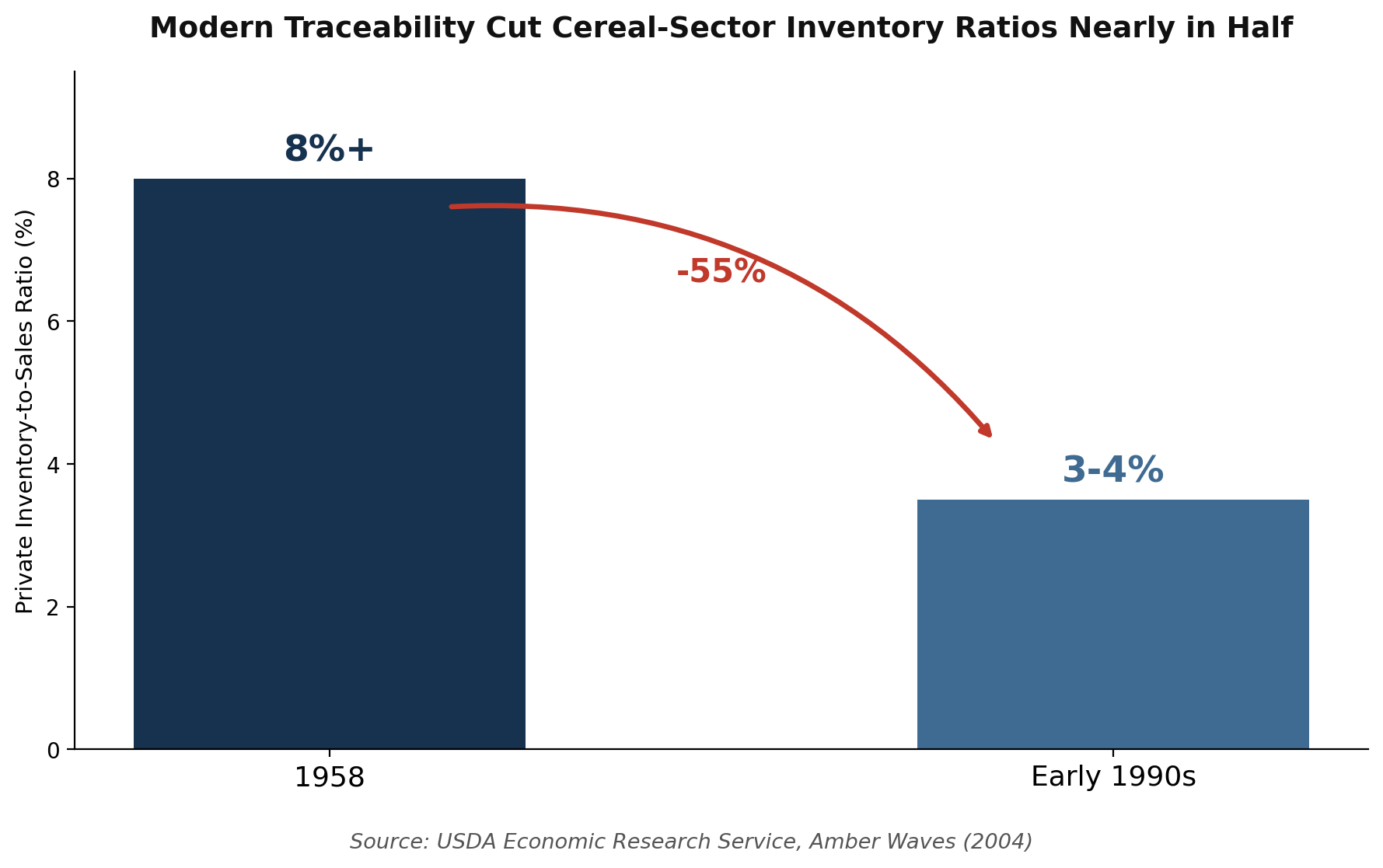
The operational payoff of mature traceability infrastructure is well documented. Modern supply chain tracking drove a significant reduction in private inventory-to-sales ratios across the cereal sector, which fell from more than 8 percent in 1958 to 3 to 4 percent by the early 1990s, enabling leaner operations and automated reordering for buyers. For procurement teams managing tight production schedules, a supplier with real-time inventory visibility translates directly into reduced safety stock requirements on your end.
A supplier’s traceability framework can be assessed across three dimensions: breadth, meaning the scope of information captured; depth, meaning how far upstream or downstream the system can trace a lot; and precision, meaning the degree of confidence in pinpointing a product’s movement at any given point. Lot traceability works like a manufacturing batch number. Every truckload can be traced back to its field, harvest date, and certification documents, the same way a food processor tracks a lot of finished product. When evaluating a new supplier, ask for a walkthrough of their lot traceability system. A supplier who cannot answer specific questions about Critical Tracking Events or lot code assignment is unlikely to meet your audit requirements.
- Third-party certifications: SQF, Kosher, and Gluten-Free certifications verify facility safety through independent annual audits.
- Electronic traceability: Suppliers using modern lot-tracking systems provide rapid data access and support automated inventory management.
- Standardized recordkeeping: Look for structured frameworks that track grain movement from the field through every handling event to your receiving dock.
- Operating history: A farming operation with a verifiable, multi-generation history of supply chain reliability carries a different risk profile than a brokerage assembled last season.
When to Choose a Specialty Grain Partner Over a Commodity Elevator
Not every sourcing requirement can be satisfied by a commodity elevator. The scenarios below indicate that a specialty grain partner, specifically one with dedicated identity-preservation infrastructure, third-party certifications, and process-specific expertise, is the right call.
- Strict genetic purity: When your product requires PCR-verified non-GMO sourcing or specific hybrid genetics to meet manufacturing specifications, a commodity channel cannot provide the chain-of-custody documentation your QA program requires.
- Organic integrity: When you require USDA Organic certification with a dedicated organic system plan to prevent commingling. Under NOP regulation Section 205.201, the plan must describe the specific management practices and physical barriers used to prevent commingling of organic and nonorganic products on a split operation, per the USDA Organic Handbook. A dedicated organic grain certification program should be able to produce that plan on request.
- Custom processing: When your formulation demands specialized handling, such as nixtamalization, custom milling, or specific color profiles like blue, pink, waxy, or flint corn, the supplier needs direct processing capability, not just sourcing access.
- Preserved identity: When your retail label depends on single-variety or non-GMO claims, look for a partner running dedicated identity-preserved handling protocols, since shared equipment and inconsistent clean-out procedures put those claims at risk.
Logistics capability deserves the same scrutiny as quality documentation. Grain suppliers operate within an integrated multimodal transportation network of trucks, barges, rail, and ocean vessels, and transportation efficiency is a primary driver of delivered cost competitiveness, particularly when offsetting domestic land and labor costs, according to the USDA Agricultural Transportation office. Shipping rates fluctuate with diesel fuel prices, barge rates, rail bids, and fuel surcharges, which means a supplier’s freight capability is not static. It requires active management. Global disruptions compound this dynamic, since conflict around the Sea of Azov and Black Sea has constrained grain exports from Russia and Ukraine, reinforcing the case for sourcing from a partner with resilient, diversified domestic multimodal shipping capability.
Grain Supplier Evaluation Checklist
Use the scorecard below to normalize quotes across every candidate before you compare a single price. A supplier who cannot check most of these boxes is not actually competing on the same terms as one who can.
| Evaluation Pillar | What to Ask For |
| Product fit | Exact grain classification, moisture and test weight specs, and available color or variety profiles matched to your formulation |
| Compliance documentation | Certificate of Analysis per lot, PCR verification for non-GMO claims, and a written traceability plan citing Critical Tracking Events |
| Certifications | SQF, Kosher, Gluten-Free, and USDA Organic system plan documentation where applicable |
| Logistics | Truckload, tote, and rail delivery options, plus a track record of on-time performance during peak freight season |
| Responsiveness | A documented process for answering a regulatory or recall inquiry within 24 hours |
Frequently Asked Questions
What food safety and cleaning standards should I expect from a commercial grain supplier?
A reputable commercial supplier should maintain active quality control and grain safety testing protocols, including multi-stage cleaning to remove foreign material, regular mycotoxin testing covering aflatoxin and vomitoxin limits, and protective treatments such as carbon dioxide to prevent pest infestation during transit and storage. Facility certifications, such as SQF, Kosher, or Gluten-Free, provide third-party verification that these systems are audited and maintained rather than simply claimed.
How do suppliers handle the risk of GMO contamination in non-GMO grain shipments?
Reliable suppliers use strict identity-preserved protocols and variety segregation, which means dedicated handling equipment, documented clean-out procedures between runs, and PCR testing to verify genetic purity before shipment. Every non-GMO lot should be accompanied by documentation tracing the grain from the originating field through each handling event to delivery. Verbal assurance is not a substitute for PCR verification records.
What documentation should organic grain shipments include on a split operation?
Under NOP regulation Section 205.201, suppliers operating split operations must document the specific management practices and physical barriers used to prevent commingling of organic and nonorganic products. This includes equipment clean-out procedures, transportation unit clean-out documentation, and physical inspection records at organic control points. Ask for a copy of the supplier’s organic system plan and confirm it addresses each of these elements explicitly.
How quickly must a supplier respond to a traceability request during a recall?
Under the FDA Food Traceability Rule, suppliers handling foods on the Food Traceability List must be able to provide required traceability records, specifically an electronic sortable spreadsheet, within 24 hours of a request during an outbreak or recall. A supplier who cannot demonstrate that their recordkeeping infrastructure supports that response window is a liability in your supply chain, regardless of price.
When does the FDA Food Traceability Rule become mandatory?
Congressional directives have delayed mandatory enforcement of the Food Traceability Rule until July 20, 2028, giving firms additional time to establish compliance readiness. That deadline is closer than it appears for operations that have not yet built the required recordkeeping infrastructure. Choosing a supplier who already operates at that compliance standard reduces your own transition risk considerably.
Evaluating and selecting a grain supplier requires a methodical approach that holds quality, compliance documentation, and logistics capability to the same standard. A supplier who excels on one dimension but falls short on another creates a gap your QA team will eventually have to close, usually under time pressure. Establishing a contracted program with an audit-ready partner, one who can furnish a Certificate of Analysis with every lot, maintain lot traceability from seed to shipment, and respond to a regulatory inquiry within 24 hours, is the most direct path to supply chain resilience.
Since 2003, Clark Specialty Grains has operated as a third-generation farming and processing operation specializing in food-grade corn and specialty grains, with complete lot-level traceability, SQF compliance, and documentation-backed quality at every stage. Ready to put this framework to work? Contact our team to request a Certificate of Analysis, discuss your specifications, or establish a contracted sourcing program.